
Deep dive: How Contentstack Agent OS and Contentful compare on AI assistants and agentic content creation

Share

We put Contentstack Agent OS and Contentful AI under a microscope to learn how these leading agentic solutions for content teams compare on the criteria that really matters.
You can’t learn much about AI capabilities from a buzzword on a website home page, and you’d probably struggle to find a CMS that doesn’t list AI features as we head towards 2027.
The real question is how much your AI tools know behind the scenes, and whether your CMS is offering tools that assist, or agents that act in a secure way on your behalf. An agent working for you needs a full grasp of your content, your brand and your customers. If one of those pillars is missing, your AI is working on a foundation of guesswork.
Here’s how Contentstack’s Agent OS and Contentful AI compare, and what that means for teams building an AI strategy that will last.
What does AI look like for Contentful today?
Contentful makes its AI features a priority, building AI directly into the editorial workflow, and focusing on supporting content teams in creating, adapting and scaling their work. For example, AI Actions handle everyday tasks such as rewriting, translation and SEO optimization, and can be run on a single entry or in bulk.
AI Suggestions give editors ideas for improvements, and Automations and Workflows bring it all together by providing notifications and approval processes. This allows content to move quickly from draft to translation or review without the need for email bottlenecks or delays.
The solution is also strong on governance. Teams can use brand guidelines to audit bulk content, and implement policies on where AI is allowed to act. Its Remote MCP server connects external AI assistants to Contentful content.
Contentful has recently launched its Content Operations Agent in Beta which can take an ask from plain language, plan out steps and run bulk AI Actions, waiting for approval before publishing. However, it only functions from within a live chat session, doesn’t offer scheduled or background runs, and can’t sync up with Contentful Personalization tools.
Teams may also run into issues with the five hour usage cap currently in the Beta version. In contrast, Contentstack’s Agent Builder agents run on triggers and schedules, streamlining everyday workflows with greater ease.
Contentstack Agent OS: Three modes of work with a single shared context
Agent OS is the Contentstack AXP AI offering. Under the hood, it draws on three foundational pillars of context: your structured content, your brand rules and (through Data Cloud) your customer data.
First, Polaris is the platform’s AI companion. Editors use it daily to find content, answer queries about content entries or brand rules, and take specific actions without leaving the UI of the CMS.
Next, beyond assistance, Contentstack has Agent Builder. Teams can design their own custom agents that take on specific operational jobs. You define the task, set up guardrails, and let the agent take the wheel.
Some examples include page creation agents that read briefs, generate a structured entry and quickly stage a review ready draft, or a brand quality review agent that can check content pre-publication to flag issues such as tone deviations or off-limits claims.
Another popular use case is a localization agent that drafts regional variants, leaving review to brand managers rather than asking them to start from scratch. Unlike Contentful, Agent builder agents run on HTTP or scheduled triggers, start from templates such as translation, compliance checks or SEO metadata, and can call outside systems through MCP servers.
Related: Browse through Contentstack’s Agent Directory for pre-built templates
UK golf travel company Golfbreaks shows what the benefits of Agent Builder look like in practice.
With more than 2,000 venue listings to maintain, and no single source of truth for each venue’s facilities, its team was stuck in endless manual review cycles. Using Agent Builder, Golfbreaks created a custom Fact Check Agent. It cross-references live Contentstack entries against venue websites and other sources, then surfaces recommendations to editors inside their existing workflow.
“We can now be alerted when a gym has closed or a spa has opened at a venue,” says Jack Simkins, Digital Product Manager at Golfbreaks. Manual review effort is down 73–83%, and the team still approves every change.
Finally, Contentstack offers Automations, which handle the rule-based work which doesn’t need reasoning. This could be anything from routing content and sending notifications to triggering downstream processes. This type of deterministic work benefits from being automated, and makes the whole system much easier to audit and more reliable day-to-day.
The linchpin underneath is Brand Kit, which turns your brand guidelines into rules which machines can read best. Your brand voice, your company tone, the terminology you prefer and the imagery standards you rely on become a playbook every agent works within.
Together, Contentstack offers governed agents that do more than complete an isolated task on request. They manage entire jobs, within the guardrails you set, with a human in the loop approving it all before you hit go-live.
AI that knows your customers and your content
Most CMS AI, including Contentful’s, works from the content in the CMS and whatever brand guidelines you make available. Contentstack AXP uses a third source — real-time customer data.
These are living profiles which are built from customer behavior across your website, your mobile app and other channels. They update automatically as customers browse, buy and engage, and feed the segments that power hyper personalization.
This changes what an agent is capable of, and the groundwork is already proving itself in the wild. Land O’Lakes used to rely on static segments: “If someone clicked on one article, they were locked into that audience, whether it was relevant or not,” says Steve Rude, Senior Manager of Digital Experience, Land O’Lakes.
Using Contentstack’s real-time customer data, the team switched to Living Audiences, segments that update automatically as customers’ behavior and interests change. For a Purina horse feed trial, they targeted visitors who had used the feed calculator and read the weight management pages, while excluding anyone who had already converted. That campaign hit a 91% conversion rate.
Across the business, Land O’Lakes now runs nearly 300 personalized experiences a year, and in one use case, visitors who saw personalized Dairy content viewed 225% more pages per session.
Now add an agent to that picture. An agent working from the same live data could take on much of the legwork, noticing a segment forming around a set of pages, drafting an on-brand variant for it and staging it for review, so the team spends its time deciding what to approve rather than building each experience from scratch. Content provides the substance, Brand Kit adds the voice and customer data steers the direction.
It’s not that Salesforce doesn’t see the same opportunity. Its plans for Contentful center on connecting content to Data 360 and Agentforce. The difference is timing and independence. In Contentstack AXP, content, data and agents already work together natively today, and they work with whatever CRM, commerce platform or tools you run.
Managed, bring your own key or build your own
We speak to customers at every stage of the AI journey. Some need something out of the box which is plug and play. Others have an LLM provider they are wedded to, and want to run their AI usage through that. A third cohort have an engineering team who are rolling up their sleeves to build instead of buy. At Contentstack we don’t play favorites.
- Managed. Agent OS gives teams Polaris, Agent Builder and Automations out of the box, with usage reported through AI Credits keeping costs predictable. For teams that want help getting started, Agent Accelerator offers hands-on guidance inside your live environment to configure production-ready agents.
- Bring your own key. If your organization already has an enterprise license with an LLM provider, you can plug your key into Agent OS and run your AI usage through it. You keep the managed experience while sticking with the model choices, contracts and policies you’ve already agreed upon.
- Build your own. For those who want more control, Contentstack’s APIs and MCP support let you connect tools like Claude or Cursor, or your own custom agents, directly to your content. Developers can build exactly the workflows they need, on the same governed foundation.
Contentful’s offering looks similar with BYO models and MCP access, but the connective tissue is a little different. All three options at Contentstack draw on the same three pillars; the content, brand rules and real-time customer data. Contentful does not currently connect to Personalization, so its AI works from the first two.
What is AI saying about your brand?
The way software buyers search has changed dramatically over the past few years, and today 51% start their research by asking an AI chatbot more often than Google. Not only that, but when an AI summary has the information they think they need, people are about half as likely to click through to a website, according to Pew Research. There are AI tools out there that are deciding whether a customer ever hears your name.
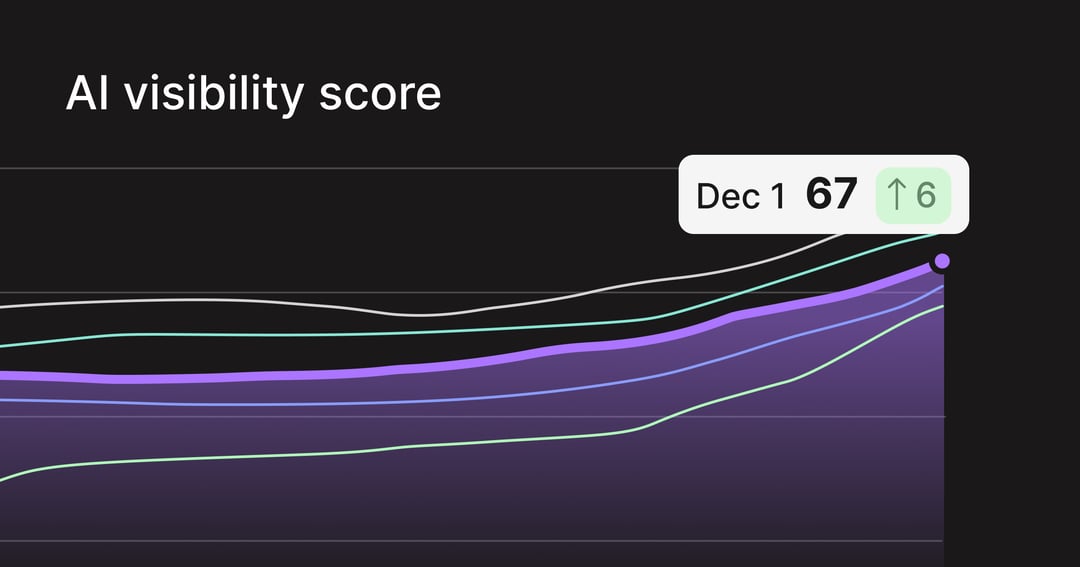
Contentstack Canoe shows you what AI tools are really saying about you, or whether they know about you at all. Enter your domain, and Contentstack Canoe drafts the questions buyers in your category are asking, puts them to the major AI answer engines and reports back. You’ll see how often your brand is named, which competitors win the answer instead, and which sources the engines trust and what to fix first. A site audit also checks whether AI crawlers can read your site in the first place.
Related: Comparing the best free AI visibility tools: Contentstack Canoe, Palmata, Otterly + more
Because Contentstack Canoe reads your public site, it works on any stack. There’s nothing to install and no need to be a Contentstack customer. Unlike Contentful’s Palmata offering for AI answer engine visibility, Contentstack Canoe also has a free plan, and can plug into Contentstack’s Agent OS through its MCP server. Palmata is a separate product, sold through the Contentful relationship.
For Contentstack customers, it closes the loop. Contentstack Canoe identifies the gap, and Agent OS can draft the fix in your CMS for your team to review. A GEO optimization agent, for example, can pull the latest Contentstack Canoe report through the MCP server and draft updates for the team to review, keeping watch for pages that are losing visibility in AI search so the human in the loop can update their metadata and structured data.
Who is your AI roadmap built for?
Salesforce completed its acquisition of Contentful on September 1, 2026, and has been clear about its plans. Contentful will be integrated natively across Customer 360, and its structured content will become accessible to Agentforce, so agents can query, assemble and deliver content directly. Salesforce has also said it will preserve the composability developers expect, and Contentful’s CEO described the product as a perfect fit for “the Salesforce stack.”
For organizations that run Salesforce across the board, that may be a welcome direction. For everyone else, it raises fair questions about whether the roadmap is being laid out for the customer or the parent company, and what happens if priorities diverge down the line. It is also worth asking at the point of renewal whether pricing and terms may change as the product is absorbed into an enterprise portfolio.
At Contentstack, we can’t answer those questions for Contentful, but we can speak for ourselves. We’re independent, a co-founder of the MACH Alliance and built to work with any CRM, commerce platform, DAM or front end, including Salesforce. Our AI roadmap answers to one group: our customers.
At a glance: Contentstack AI vs. Contentful AI
| Contentstack | Contentful | |
| In-platform AI | Polaris, a conversational companion that finds, answers and acts on content and brand rules | AI Actions and AI Suggestions built into the editorial workflow |
| Agents | Agent Builder for custom agents that handle whole jobs within guardrails | Content Operations Agent (Beta) |
| Rule-based automation | Automations | Automations and Workflows |
| Brand governance | Brand Kit turns brand guidelines into machine-readable rules | Bulk content audits against brand guidelines |
| Customer data | Native real-time customer data through Data Cloud, with living profiles and segments | Not currently linked to Personalization |
| Personalization | Personalize, powered by real-time customer data | Contentful Personalization |
| AI answer engine visibility | Contentstack Canoe, integrated with Agent OS and with a free offering | Contentful Palmata, a separate product, sold through the Contentful relationship |
| Model choice | Managed, or bring your own key | Bring your own models |
| Developer access | APIs and MCP | APIs and Remote MCP |
| Roadmap | Independent | Part of Salesforce; being integrated with Customer 360 and Agentforce |
Contentstack and Contentful both hit the AI keywords. They both have AI built into the content workflow, and let you bring your own models and connect your external tools. If your AI priority is making sure you can scale writing, translation and review, either one can do the job.
Once you move past assistance, the differences start to appear. Agents at Contentstack work from real-time personalized customer data and are governed by content and brand rules. You set up guardrails, and agents handle entire workflows from templates and triggers. And behind the scenes, there’s no parent company strategy looming in the rear-view mirror.
Your agents can only be as powerful as the data behind them, and Contentstack offers all three pillars, content, brand rules, and real-time customer data, running on a roadmap that answers only to our customers. That's how Golfbreaks’ empowered the Fact Check Agent to take on a whole job from end-to-end, and what turns a Land O’Lakes-style living audience into something an agent can act on.
Want to see Agent OS in action? Schedule a call. And to find out what AI is telling your buyers about your brand, try Contentstack Canoe for free.