
Meet Contentstack Canoe: See what AI tells your buyers, then fix the answers you lose

Share

Contentstack Canoe is our new, publicly accessible AI visibility tool that tells you how your brand shows up when buyers ask AI for a recommendation, and whether you or your competitors win that answer.
Setup takes minutes, you don't need to be an existing Contentstack customer to get started and there's a free plan that stays free. Here's how it works.
Right now, a buyer in your category is asking ChatGPT which vendors belong on their shortlist. The answer names a few brands, describes each one in a sentence or two and cites the sources it trusted. Your brand is either in that answer or it isn't.
That conversation is becoming step one of the buying process. ChatGPT, Gemini, Perplexity and Claude are each writing their own version of your brand description. You can rank first on Google and still never make it into the answer.
Contentstack Canoe shows you what those engines say. Just type in your URL, and in about two minutes, you'll see whether you're named, how you're described, which competitors win the answer and what to fix first. Below, you’ll learn more about why AI visibility matters, how Contentstack Canoe works, and how to use it for free, even if you’re not a Contentstack customer.
The demand didn't disappear. It went into the answer
If your organic traffic has gone flat and you can't see where the demand went, there's a good chance it moved into an AI-generated answer.
In June 2026, bot traffic passed human traffic online for the first time in the Internet's history. Cloudflare CEO Matthew Prince reported that 57.4% of web requests were initiated by bots, compared with 42.6% coming from humans; that number is now around 65% as of late September.
Other recent research points the same way:
- Adobe measured traffic from AI sources to US retail sites was up 393% year over year in Q1 2026.
- Bain found 80% of consumers rely on the AI-written result in at least 40% of their searches.
- Gartner found 45% of B2B buyers used generative AI in a recent purchase, mostly to research vendors.
Buyers still research. They just do more of it in a conversation with answer engines, and the conversation shapes the shortlist before anyone reaches your site. If you want to go deeper on how that shift changes content strategy, our enterprise AI search playbook covers it in detail.
Why AI visibility needs its own measurement
SEO tools report keyword rankings, search volume and position on a results page. Those metrics are still worth tracking, but AI search visibility asks different questions. Does the generated answer name you? In what terms? Which pages did the engine cite to say it?
A brand can hold position one on Google and never be mentioned by Claude or Perplexity, and a rank tracker won't show you why that’s happening.
You'll hear this space called AEO or GEO. Whatever your team calls it, the goal remains the same. Know what the engines say about you, and optimize it.
Meet Contentstack Canoe
Contentstack Canoe is our new, publicly accessible AI visibility tool that tells you how your brand shows up when buyers ask AI for a recommendation, and whether you or your competitors win that answer.
You give it your URL. Contentstack Canoe drafts your products, buyer personas and competitors from your site, turns them into the questions your buyers ask and runs them on up to four AI engines: ChatGPT, Gemini, Perplexity and Claude. It reports whether your brand appeared, how it was described, which competitors won the answer and which sources the engines cited. Every run ends with up to ten ranked fixes.
Setup takes minutes. There's a free plan, and it stays free.
How it works, in five steps
- Add your brand. Enter your domain. Contentstack Canoe reads your public site and fills in your brand name, name variations, region and language.
- Review what it found. Five suggested competitors (track up to 10), the product to monitor and one to 10 buyer personas, all editable. This grounding step shapes everything after it, so it's worth a few careful minutes.
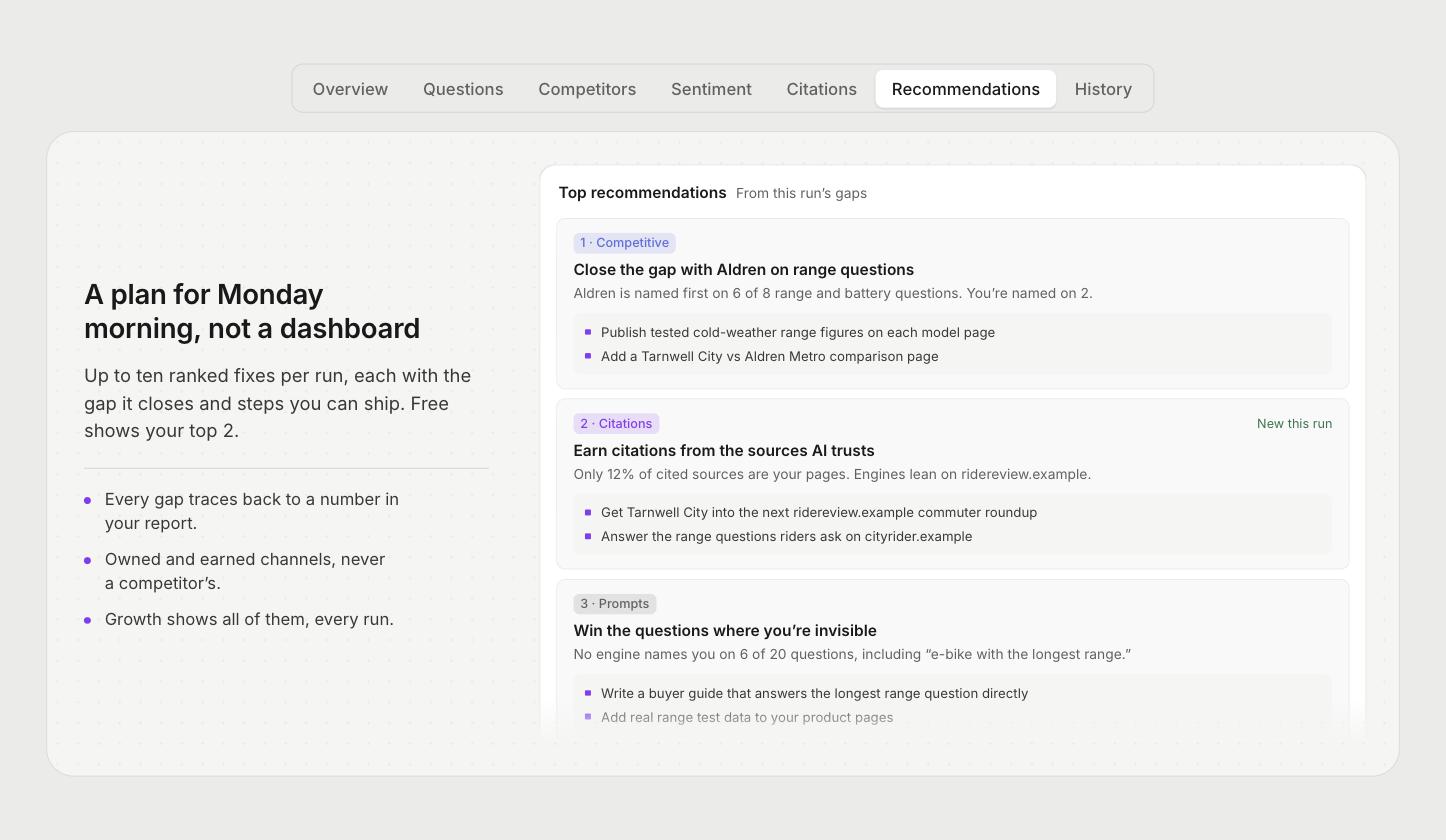
- Review the questions. Contentstack Canoe drafts the questions your buyers ask from that grounding and tags each one as awareness, consideration or decision. Free runs up to 10 of them as generated. On Growth you can edit, add or delete any of them, up to 100 per monitor.
- Set the cadence. On Growth, pick daily monitoring if you publish often or you're mid-launch, since AI engines that search the web can pick up changes within days. Weekly or monthly monitoring works well for tracking a steady baseline. Free runs monthly, and any plan can run a monitor on demand, say right after you publish something new.
- Read the report. It takes about two minutes to generate.
There's no step where you pick engines. Every engine on your plan runs every time (all four on Growth, ChatGPT and Gemini on Free), and you filter by engine in the dashboard once the report is ready.
What you get from every report
Each report does three jobs.
1. See your AI visibility
Find out whether the engines name you, how often and how they describe you. The report opens on four top-line metrics: Overall Score, Visibility, Brand Ranking and Sentiment. Sentiment is easy to skip past, and it shouldn't be. Getting mentioned and getting recommended warmly are two very different outcomes.
2. Benchmark against the competitors you care about
A leaderboard shows share of voice and average position for each competitor you named, engine by engine. Pair that with the Buyer Journey view and you can see the exact stage where you lose the answer. Maybe you show up for awareness questions and disappear at decision time. That's fixable once you can see it.
3. Know what to do next
The Sources section shows every citation, split across your content, competitor content and third-party sites, plus the top domains the engines lean on. A site audit, included on every plan, gives you an AI Readiness Score. It checks whether AI crawlers can reach your site (robots.txt, CDN and firewall blocks, your sitemap and llms.txt) and reviews up to 50 pages for issues like broken pages, missing titles and thin content, with a fix for each.
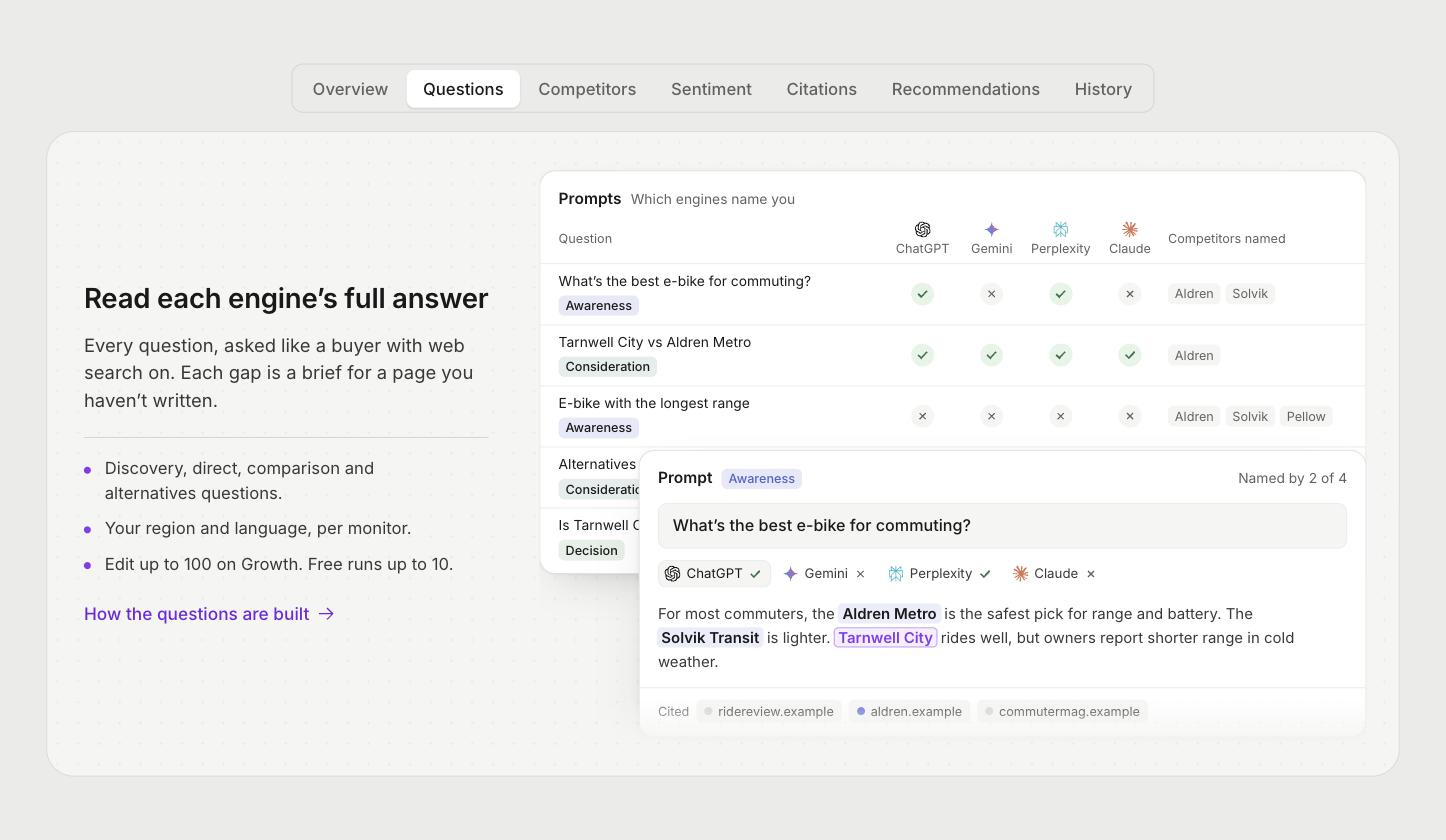
Then comes the part most teams go straight to: Top Recommendations, up to ten ranked fixes per run, each with the gap it closes and the steps to ship it. Free shows your top 2. Run it again after you ship changes, and see which scores moved.
Contentstack Canoe hands your team (or your agents) a clear plan for what to change and why. The rewriting stays in your hands.
Built on your brand, so the numbers hold up
Every question Contentstack Canoe asks starts from your own site, your products, your customer profiles and your named competitors, and you can see and edit all of it before a run. When someone in a leadership review asks where the questions came from, you have a real answer.
The scoring is built to be trusted, too. Mentions, position and citations are counted in code, so runs compare cleanly over time. Sentiment is a model's read, and the report says so.
Could you just ask ChatGPT yourself? Sure, once. Now try it across four engines, 20 questions and 10 competitors every week, scored the same way every time so the numbers line up. That repeatability is the product. You get the same method every run and a trend line you can take to your CMO.
Who it's for
- SEO and growth marketers who need a number they can defend in a leadership review and a clear list of what to fix
- Brand and product marketers who want to know how the engines describe them and how sentiment compares with competitors
- Agencies and consultants managing multiple client brands with one consistent method and PDF reports
- Technical teams who'd rather pull the data into their own tools over the API or MCP than learn another dashboard
- Enterprise teams that need SSO, an SLA, data residency and a named success manager (Enterprise is planned for early 2027)
Ready for your agents
On Growth, Contentstack Canoe comes with a remote MCP server and a REST API. Add an API key to Claude, Cursor, VS Code or another MCP client, and your agents can read your reports and recommendations and start new runs.
If you run Contentstack, agents in Agent OS can read Contentstack Canoe’s recommendations and draft the content changes as entries your team reviews. You don't need Contentstack to use it, though. It measures any page your brand owns, on any stack, and runs as a standalone product on its own infrastructure.
Plans and pricing
- Free: $0, with no card and no time limit. One brand, 20 prompts a month on ChatGPT and Gemini, a site audit, your top 2 recommendations and a report that re-runs itself every month.
- Growth: $279 a month or $2,790 a year, a limited-time launch price. Five brands, all four engines, 2,000 prompts a month, up to 100 questions per monitor, every recommendation, six months of history, PDF reports and API and MCP access. Add-ons are one-time purchases at launch prices: up to five more brands at $59 each, and prompt packs of 400 prompts at $119 each, up to four packs. Extra prompts are used after your monthly allowance, roll over and last 12 months.
- Enterprise: Custom pricing, planned for early 2027. SSO and SCIM, an SLA, data residency, premium models, access to 200+ AI models, unlimited brands and history (fair use applies) and a named success manager. It's open to every team, Contentstack customer or not, so contact us for pricing. Existing Contentstack enterprise customers get Growth at no extra cost through December 31, 2026.
Free needs no card and Growth is paid by card, so you can sign up and run a report without talking to anyone.
Find out what AI tells your buyers
Your buyers are already asking AI who to consider. Contentstack Canoe shows you what the engines tell them, who wins those answers and what to fix first, then helps you prove the fixes worked. We've used it on our own brand since July, and it's now at the center of how we think about AI visibility.
Run your first AI visibility report free and see how your brand shows up in the answer.
FAQs
What is Contentstack Canoe?
Contentstack Canoe is Contentstack's AI visibility tool. It runs the questions a brand's buyers ask across ChatGPT, Gemini, Perplexity and Claude (ChatGPT and Gemini on Free), then reports whether the brand appeared, how it was described, which competitors won the answer, which sources the engines cited and a ranked list of what to fix.
How is AI visibility different from SEO?
SEO tools measure keyword rankings, search volume and position on a results page. AI visibility measures whether an AI-generated answer names a brand, how it describes that brand and which pages it cites. Contentstack Canoe complements an existing SEO stack rather than replacing technical SEO tools.
Where do Contentstack Canoe's questions come from?
It drafts its questions from the brand's own website, using its products, customer profiles and up to 10 named competitors. Every question is tagged to the awareness, consideration or decision stage of the buyer journey, and on Growth you can edit any of them before a run.
Do I need to use Contentstack CMS to use Contentstack Canoe?
No. It is a standalone product that measures any page a brand owns on any stack. Contentstack customers can also connect it to Agent OS through its MCP server so agents can draft fixes in the CMS for review.
Is there a free version of Contentstack Canoe?
Yes. The Free plan costs $0, has no time limit and covers one brand with 20 prompts a month on ChatGPT and Gemini. The Growth plan costs $279 a month or $2,790 a year at limited-time launch pricing and adds all four engines, five brands and API and MCP access.