
Your next holiday shopper might send an AI assistant first

Share

How AI assistants are changing the way shoppers find products this holiday season, and what I'd fix before Black Friday.
A few weeks ago I asked ChatGPT what the Sunday brunch cruise costs on one of our demo pages. The page says $79. ChatGPT told me about a $62 cruise in St. Louis.
Red Panda Detours is a made-up Chicago tour company we run on Contentstack to test exactly this kind of thing. Its brunch page loads the price with JavaScript. You and I see $79 the moment the page opens. The assistant opened the same page, couldn't find a price it could read, and filled the gap with another company's cruise.
I've thought about that a lot since. This holiday season, millions of shoppers will ask an assistant what to buy, and the assistant will go and read brand sites to answer them. Some of those sites will have the same problem my demo page had.
What the numbers say this season
Adobe expects traffic from AI tools to US retail sites to grow 130% year over year between November 1 and December 31, and 159% on Thanksgiving Day. Last season that same traffic grew 693.4%. Adobe also points out that the number of people shopping this way is still modest.
Salesforce says AI and agents drove $262 billion in 2025 holiday sales, or 20% of all retail sales. This year it predicts 20% of holiday ecommerce traffic will come from AI chat agents, counting shopper assistants, autonomous agents and price-checking bots.
People who try it seem to like it. In an Adobe survey of 5,000 consumers, 77% of those who had used AI to shop said it made them more confident in what they bought.
Your site has two audiences now
The first is people. They still browse, compare and buy. More of them now start with a question in ChatGPT, Gemini, Perplexity or Claude, and some never reach your site at all. Pew found that when Google shows an AI summary, people click a regular result on 8% of visits, against 15% when there's no summary.
The second audience is the agents those people send. They take a lot more than they give back. Cloudflare's 2025 Year in Review found Anthropic's crawlers made up to 500,000 requests for every referral they sent, and OpenAI's up to 3,700 in March. Akamai found that commerce sites got 47.9% of all the AI bot traffic it saw in the second half of 2025.
The agents do different jobs. Training crawlers like GPTBot and ClaudeBot collect content for future models. Search crawlers like OAI-SearchBot and PerplexityBot build the index the assistants search. User fetchers like ChatGPT-User and Claude-User visit your page the moment someone asks about it, so they're the ones answering your shoppers in real time. A blanket bot rule at your CDN can block any of them, and usually nobody notices.
Something else I noticed while watching agents on our own sites: the only ones that asked for Markdown were coding agents. The assistants shoppers use read the HTML, so that's where your facts need to live.
What we see on our own CDN
Contentstack's CDN carries our own website, thousands of customer sites and the content APIs behind them. I pulled 90 days of traffic from it, August 11 to November 8, to see what these agents actually do.
- AI crawlers and assistants made about 650 million to 1.6 billion of the roughly 620 billion requests, so about 0.1% to 0.3% of all traffic. The low number only counts requests that came from the AI companies' own networks. The high one counts every request that named an AI bot.
- Weekly requests from AI search crawlers like OAI-SearchBot and PerplexityBot grew about six to nine times since mid August.
- Live fetches, the ones an assistant makes the moment a person asks, fell by more than half over the same weeks. ChatGPT-User is the biggest of these.
- When an assistant did fetch a page for someone, about 9 in 10 of those requests got a normal response. Fewer than 1 in 200 were blocked at our edge.
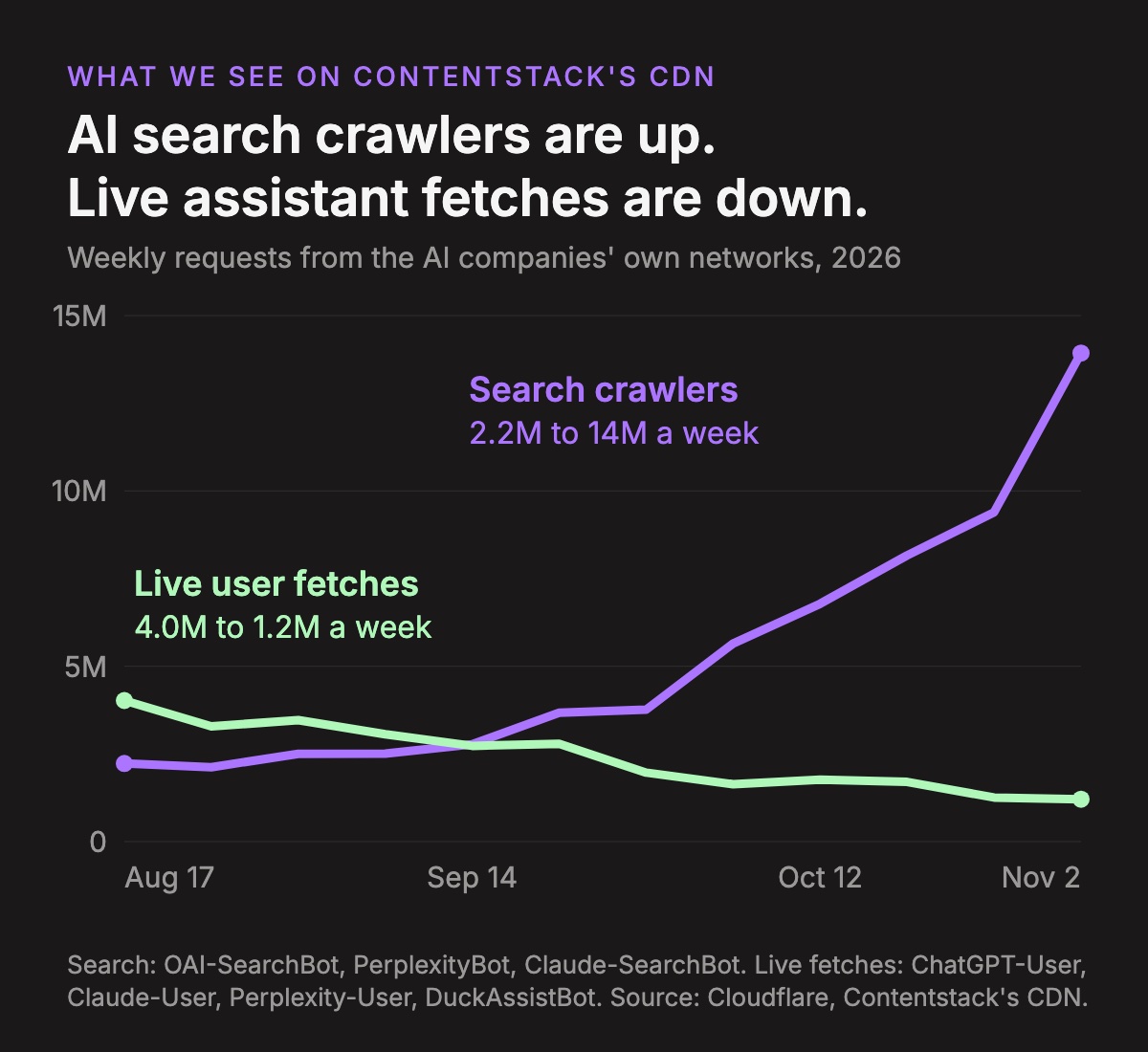
I think the assistants are leaning more on their own search index and fetching pages live less often. If that's right, the visit that matters most is the search crawler's. If your gift guide is hard to read when OAI-SearchBot or PerplexityBot comes by in November, the answer your shopper gets in December could be built from an old or empty copy.
I can't compare any of this with last season, because our CDN only keeps this level of detail for about 13 weeks. The holiday rush also hasn't started yet. If the current trend holds, AI agents will make somewhere between 570 million and 1.8 billion requests on our CDN between November 1 and December 31.
What I'd do before Black Friday
- Ask the questions your shoppers ask. "Best gift for a cyclist under $100." "Warmest winter jacket for kids." Put them to ChatGPT, Gemini, Perplexity and Claude, and write down who gets named and which sources get cited. Ask more than once. SparkToro found AI tools give the same list of brands less than 1 in 100 times, so a single answer tells you very little.
- Let the right agents in. Check robots.txt and your CDN bot rules for the search crawlers and user fetchers. Make a separate, deliberate call on training crawlers.
- Put the facts in the HTML. Price, sizes, stock, shipping cutoffs and the return window. If something only shows up after JavaScript runs, assume an agent won't see it. That's how I ended up with a $62 cruise in St. Louis.
- Keep holiday details current. Gift guides, promo dates and delivery deadlines change every week in December. An assistant quoting last year's shipping cutoff can cost you more than an assistant that says nothing at all.
- Measure what comes back. Look for referrals from chatgpt.com, perplexity.ai and gemini.google.com in your analytics. Treat that number as a floor, since app traffic and copied links often show up with no referrer.
How we're closing the loop
In a six-week season, speed matters. You need to spot a gap, fix it and check the fix while the season is still running. Here's how we're building that loop at Contentstack.
- See what AI says. Contentstack Canoe asks ChatGPT, Gemini, Perplexity and Claude the questions your shoppers ask, then shows who gets named, which sources get cited and what to fix first. Before it suggests new content, it checks the pages you already have.
- See what the agents read. Agent traffic in Contentstack Canoe shows which AI agents read which pages, verified at the edge through Cloudflare, and which of your questions those pages answer. If a gift guide gets heavy agent traffic and the assistants still don't mention you, that's the page to fix first.
- Fix it in the CMS. Agent OS takes a recommendation and drafts the change as a Contentstack entry, like a refreshed gift guide. An editor reviews it and publishes.
- Check that it worked. We're building this step next. When the fix goes live, Contentstack Canoe will re-ask just those questions and show whether the answers changed.
Here's how that could look in December. On Monday, agent traffic shows your stocking stuffer page getting far more reads than usual. You hand the recommendation to Agent OS, and by Tuesday there's a draft that puts prices and shipping cutoffs in the HTML and answers the questions shoppers are asking. An editor approves it before lunch. On Wednesday you re-run those questions and see whether the assistants have started naming you. You can do all of that in Contentstack today, up to the re-run. We're working on making that last step automatic.
Where I've landed
For a growing share of shoppers this season, being discovered means being one of the brands an assistant names in a two-line answer, often based on pages the shopper never opens. I don't think any of us know yet what that does to a holiday plan, and I'm looking forward to finding out.
If you want to see where you stand, ask the engines a few of your shoppers' questions this week. You can also run the same check in Contentstack Canoe on the free plan.
Sources
- Adobe, US holiday shopping forecast, Sep 28, 2026: news.adobe.com/news/2026/09/adobe-us-holiday-shopping-season-to-hit-record
- Adobe, 2025 holiday season results, Jan 7, 2026: news.adobe.com/news/2026/01/adobe-holiday-shopping-season
- Salesforce, 2025 holiday shopping data, Jan 8, 2026: salesforce.com/news/stories/2025-holiday-shopping-data
- Salesforce, 2026 holiday retail predictions, Jul 20, 2026: salesforce.com/blog/holiday-retail-predictions-2026
- Pew Research Center, Jul 22, 2025: pewresearch.org short read on AI summaries and clicks
- Cloudflare Radar 2025 Year in Review, Dec 15, 2025: blog.cloudflare.com/radar-2025-year-in-review
- Akamai, commerce and AI bots, Jul 15, 2026: akamai.com newsroom
- SparkToro, AI brand recommendation consistency, Jan 28, 2026: sparktoro.com/blog
- Contentstack CDN: Cloudflare analytics for Contentstack's CDN, all production zones, August 11 to November 8, 2026. Sampled estimates, rounded.
- Red Panda Detours examples: Contentstack Canoe team tests on a fictional demo brand, October 2026.
FAQ
Which AI agents should I let crawl my holiday pages?
Let in the search crawlers, like OAI-SearchBot, PerplexityBot and Claude-SearchBot, and the user fetchers, like ChatGPT-User, Claude-User and Perplexity-User. Those are the ones that help assistants answer your shoppers. Training crawlers, like GPTBot and ClaudeBot, are a separate decision you can make on your own terms.
How do I see AI referrals in my analytics?
Filter your referral traffic for chatgpt.com, perplexity.ai and gemini.google.com. Treat what you find as a floor, because app traffic and copied links often arrive with no referrer at all.
Why can't an AI assistant see my prices?
If the price, stock level or shipping date only shows up after JavaScript runs, many agents won't see it. Put those details in the HTML your server sends, and check a page by viewing its source.
Can I check what AI assistants say about my brand for free?
Yes. Contentstack Canoe has a free plan that asks ChatGPT and Gemini your shoppers' questions and shows who gets named and which sources get cited.