

The 2026 Agentic Enterprise Report

Enterprise leaders have spent the past two years being told that agentic AI is the next major shift in how work gets done. The pitch is compelling: autonomous systems that don’t just generate content or answer questions, but reason across tasks, take action and operate with minimal human intervention.
Boards are asking about it. Vendors are selling it. Competitors, or so it seems, are already doing it. And the pressure to move quickly, decisively and at scale is relentless.
But the reality for most enterprise leaders is something messier and more exhausting than the hype cycle suggests. While most modern teams have stood up plenty of vibe-coded prototypes and agentic pilot programs over the past few years, turning those experiments into measurable business impact has proven to be a high bar to clear.
So what’s causing this stressful gap between experimentation and impact? And what separates the organizations making real progress on AI adoption and ROI from those still searching for traction.
In May 2026, Contentstack asked 621 enterprise digital leaders who are directly involved in AI strategy or implementation at their organizations to tell us their current level of progress with launching AI programs in production. (Skip to the end of this report for a full breakdown of our participants.)
We also asked where digital teams are seeing the biggest ROI from agentic programs, how AI is impacting their software spend and what they’d do differently if they had to start over from scratch.
We created this report to give you realistic benchmarks on how your team stacks up against other enterprises, as well as some valuable guidance on how to drive org-wide AI adoption and prioritize your investments in agentic technology.
1.A pulse check on progress: AI expectation vs. reality
Digital executives are drowning in agentic AI expectations. According to our research:
- 44% of enterprise leaders say the volume of agentic AI ideas, tools and frameworks their organization is being asked to evaluate has become overwhelming, and
- 53% say it’s becoming harder to separate truly actionable agentic AI opportunities from hype.
At the same time, there is near-universal agreement at the executive level that agentic AI is not optional.
89% of our survey respondents said that agentic AI is a strategic priority for their organization in 2026, while 86% went as far as to say the long term success of their business will depend on how effectively they deploy and adopt agentic AI.


Fortunately, most enterprises have taken at least some early steps out of the experimentation phase, and have AI programs up-and-running in their business.
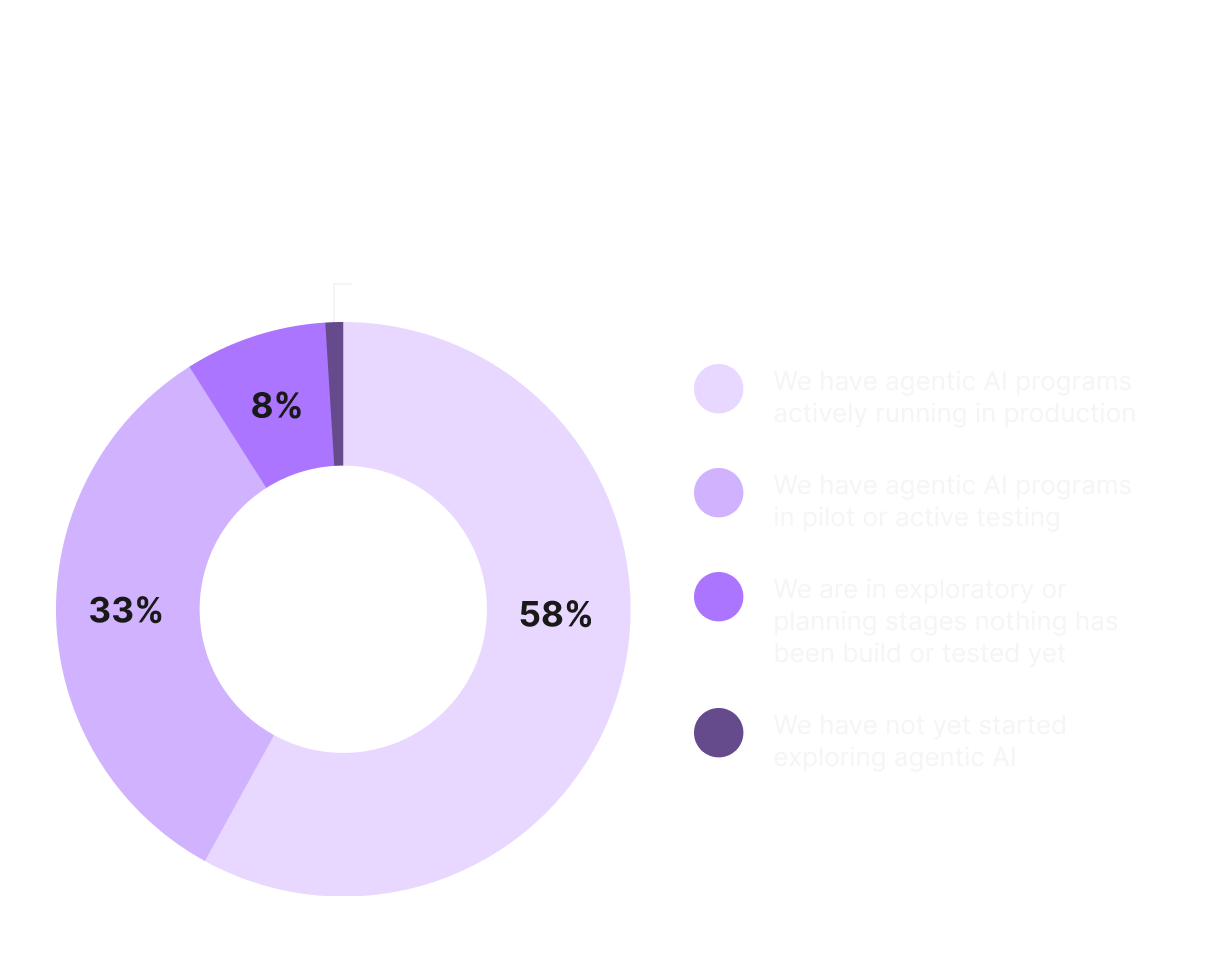
When we asked our survey participants how they’d best describe where their organization currently stands with agentic AI:
- 58% said they have agentic AI programs actively running in production
- 33% have agentic AI programs in pilot or active testing
- 8% are in exploratory or planning stages, with nothing built or tested yet
- 1% have not yet started exploring agentic AI
The enterprises that are ahead of the curve on launching production-ready AI agents are also making significant progress on getting them adopted across the organization. Of the 58% of survey respondents who said they have agentic AI programs actively running in production:
- 69% said those programs are actively used across multiple departments or business units
- 20% said their agentic AI programs are contained within a single department or team
- 10% said it varies — some programs are cross-departmental, others are not
Among our respondent pool as a whole, just 40% of enterprises have agentic AI programs actively running in production that are used by multiple departments.
Most enterprises are on track, but FOMO remains
A significant number of our survey respondents (41%) feel their organization is falling behind their competitors on agentic AI adoption, illustrating a common area of anxiety among enterprise leaders.

Nevertheless, most of the leaders we spoke to are feeling some measure of optimism about how far they’ve come. When we asked our survey respondents to describe the overall progress of their organization's agentic AI programs in 2026 relative to their expectations:
- 48% said they are roughly on track with where they expected to be
- 31% said they are ahead of where they expected to be
- 14% said they are somewhat behind where they expected to be
- 6% are significantly behind where they expected to be
- And 1% said it’s too early to assess progress
We wanted to dig deeper into how the winners are winning, so we asked the combined 79% of respondents who said their agentic AI programs were on track or ahead of expectations to tell us the single most important factor in that success. The six most common responses were:
- High-quality, accessible data and content infrastructure - cited by 25% of respondents
- A well-defined strategy and roadmap - 18%
- A skilled internal team with relevant AI expertise - 13%
- The right technology tools and platforms - 11%
- Strong cross-functional alignment and collaboration - 10%
- Strong executive sponsorship and buy-in - 10%
Data and content infrastructure will become a recurring theme in this report, as it’s the foundational piece that makes AI adoption and impact possible.
As a final status-check, we asked our digital leaders to share their organization’s current resource level when it comes to pursuing agentic AI programs. While a slight majority of respondents feel properly resourced, nearly half feel under-resourced to some degree:
- 52% said they have the resources they need to pursue agentic AI at the pace the business requires
- 35% have some resources in place but not enough to move as fast as they’d like
- 12% are significantly under-resourced relative to their agentic AI ambitions
- 1% have not yet allocated dedicated resources to agentic AI
Later in this report, we’ll present our data on how enterprise companies are directing their AI investment dollars, and which technology categories they’re cutting back on in order to pay for it.
2.What are we building and who’s responsible?
One of the most important structural questions in enterprise agentic AI right now is whether organizations are focusing inward, to drive operational efficiency, or outward, to shape the experiences of customers and prospects.
The answer has significant implications for how programs are governed, how ROI gets measured and how quickly value is realized.
When we asked our survey respondents where their current agentic AI efforts are primarily focused, internal use cases had a slight edge:
- 37% of enterprises are focusing agentic AI efforts primarily on internal operations and efficiency
- 10% are focusing primarily on external, customer-facing experiences
- While 53% of enterprises are actively pursuing both internal and external use cases
For digital leaders who have deployed or actively tested internal AI agents, the six most popular use-cases are:
- Agents that automate workflows across tools and systems (e.g. approvals, routing, notifications) - cited by 54% of the cohort
- Analytics accelerators to help teams find and analyze data quickly - 51%
- Internal knowledge chatbots to help teams surface information faster - 48%
- Agents that automate strategic creative development, from shaping briefs to initiating campaign workflows - 43%
- Agents that automate research and analysis of public brand mentions or media coverage - 40%
- HR or recruiting agents that assist with candidate screening or employee onboarding - 38%
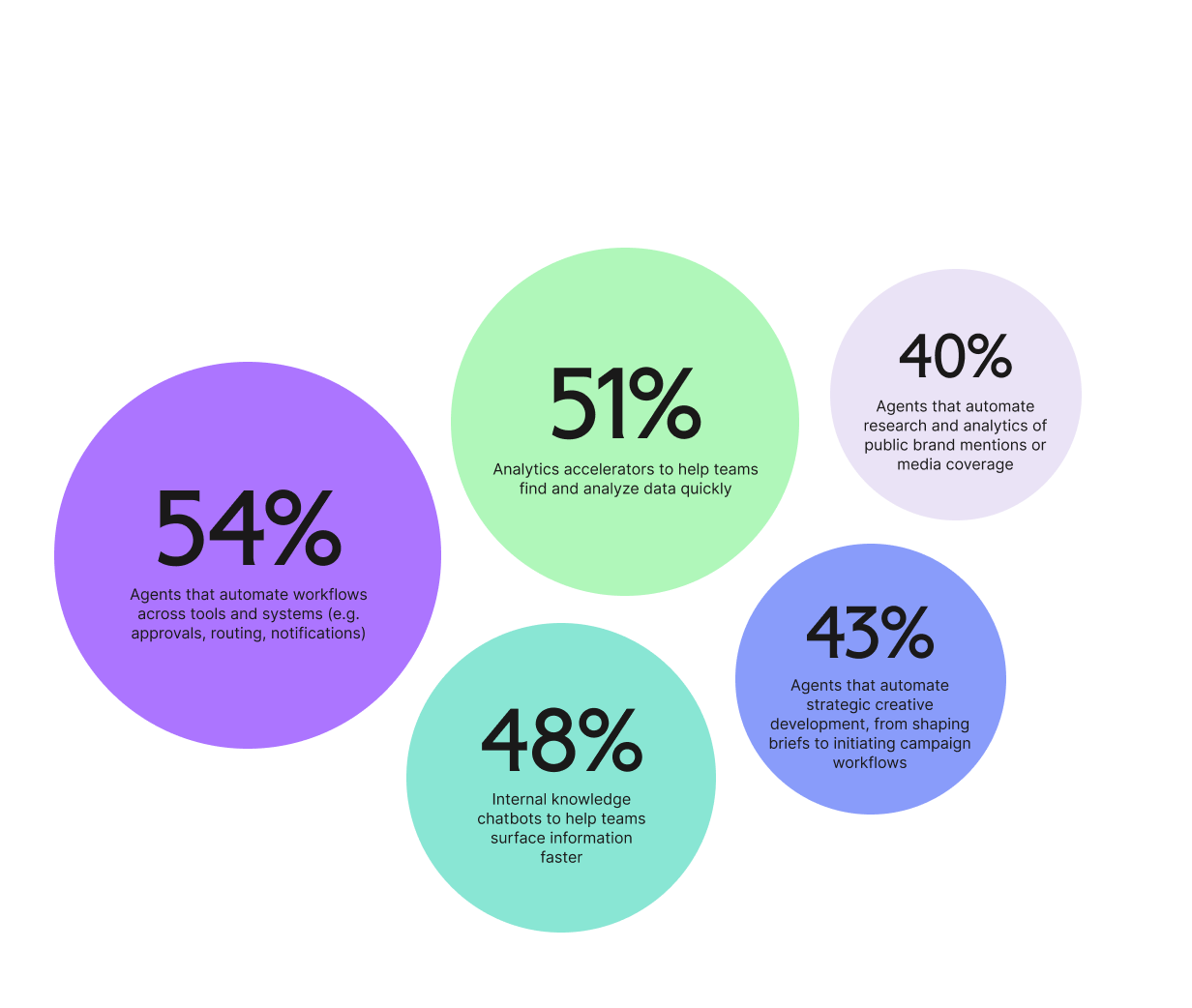
Automating repetitive processes and helping team members locate important information quickly are big time savers, and it’s no surprise to see these use-cases at the top of the leaderboard.
For digital leaders who have deployed or actively tested external, customer facing AI agents, the six most popular use-cases are:
- Customer support agents that handle live service interactions autonomously - cited by 56% of the cohort
- On-site chatbots to help visitors find information or navigate the experience - 52%
- Agents that proactively surface recommendations or next-best-action prompts to customers - 48%
- Agents that personalize email or outbound outreach based on recipient behavior - 44%
- Agents that generate or adapt landing pages or product content in real time - 41%
- Agents that optimize buyer journeys based on known visitor behavior - 40%
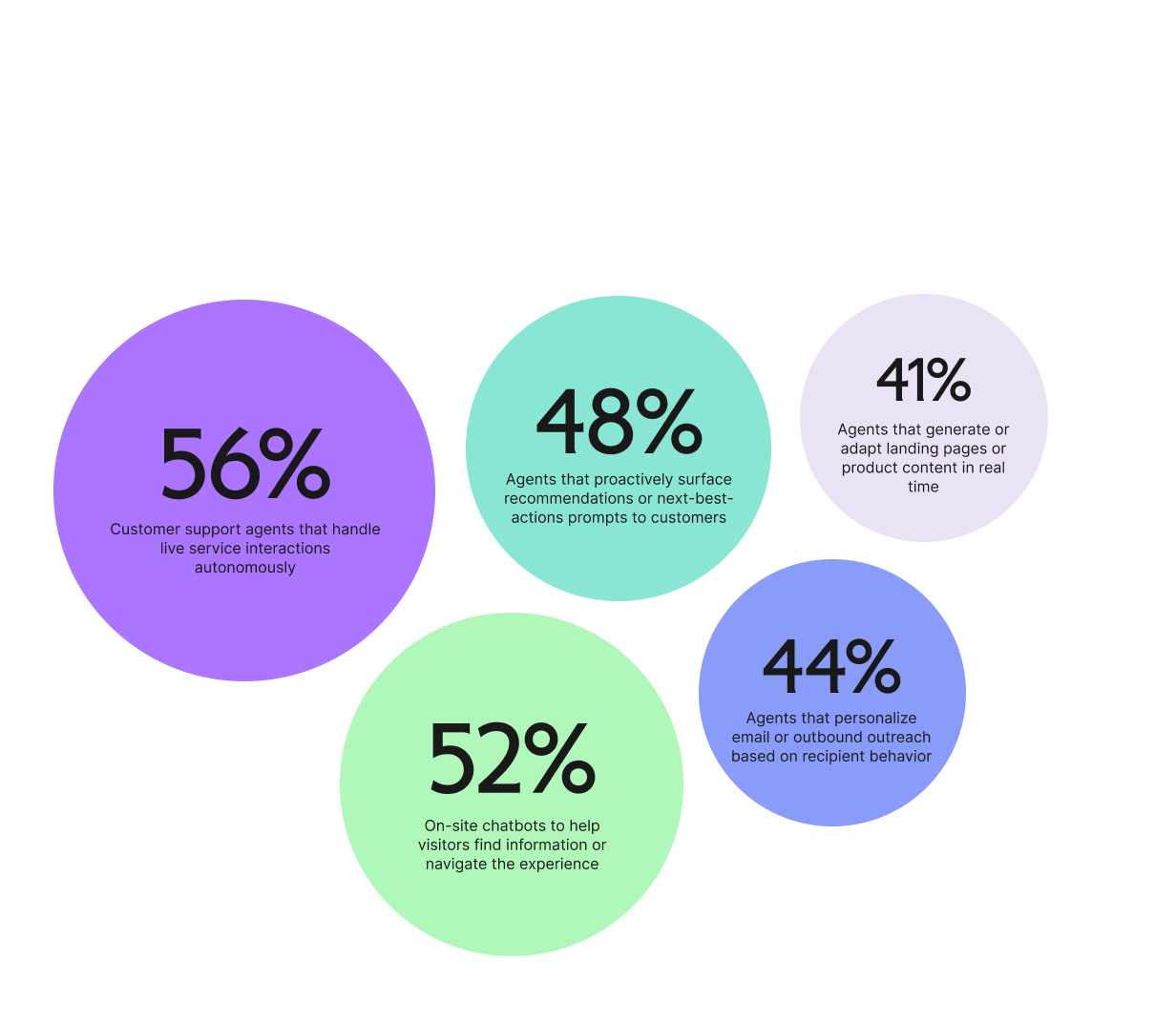
As the data shows, companies are still focused on using external-facing AI programs to scale the effort of answering customer questions. Creating adaptive experiences and buyer journeys are lower on the list (for now), and could represent an opportunity for enterprises to differentiate themselves among their competitors.
But whether your team’s AI focus is internal or external use-cases, just make sure that you’re directing your agentic efforts at worthy targets.
“Most firms start with what an agent can do and automate it, whether or not the task was ever worth doing well,” says Seventh Bear Founder Robert Rose. “The highest-ROI players start at the other end — they ask which work actually deserves a human, and only then ask which of those tasks an agent should carry. It's the difference between automating your friction and understanding it first.”
IT departments are calling the shots — but should they be?
Without formal ownership, agentic programs fail. In fact, a full 42% of the enterprise leaders we surveyed told us that the lack of a clear internal owner directly delayed an agentic AI initiative at their organization in the past 12 months.

To examine this, we asked our survey respondents who is primarily responsible for creating agentic AI processes at their organizations:
- 47% of respondents credited a central IT or engineering team for building AI agents at their company
- 25% said agent creation was the responsibility of a dedicated AI or data function
- 16% have a cross-functional team with members from multiple departments building AI programs
- 7% said individual business units or departments build agentic programs at their company, each operating independently
- 2% said it’s the marketing team’s responsibility to create AI processes at their organization
- And 1% said they don't have a defined owner for this, making it nobody’s responsibility
We also asked our survey respondents who’s primarily responsible for ensuring that agentic AI processes are actually adopted and used across their organizations, and some familiar names were at the top of the list:
- 37% of respondents said that their central IT or engineering team was chiefly responsible for AI adoption
- 28% said AI adoption was primarily the responsibility of a cross-functional team with members from multiple departments
- 19% said AI adoption and usage was the responsibility of a dedicated AI or data function at their company
- 11% said individual business units or departments operating independently drive AI adoption and usage at their company
- 3% said it’s the marketing team’s responsibility to ensure AI processes are used at their organization
- And 2% don't have a clearly defined owner for AI adoption and usage
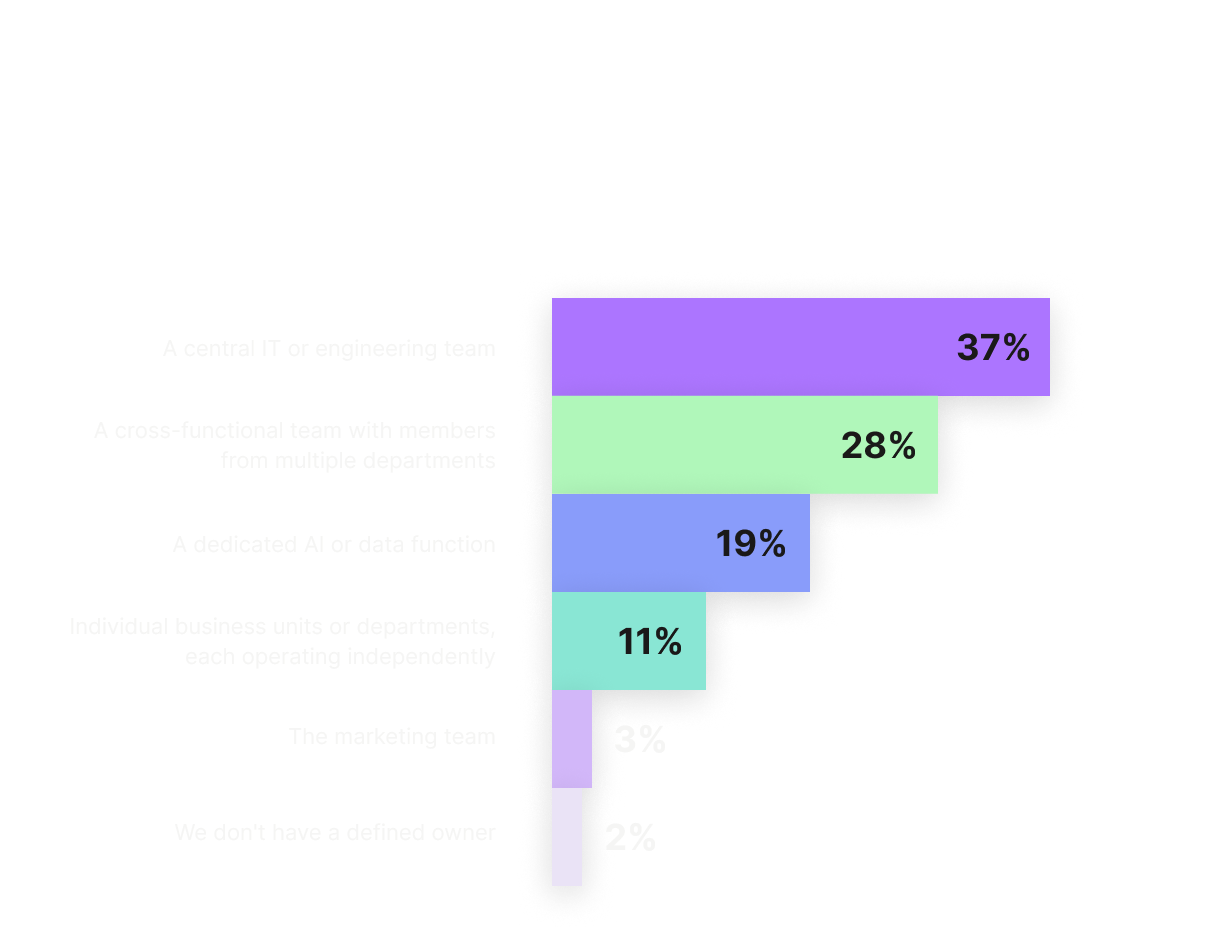
In short, IT and engineering teams are leading when it comes to driving agentic AI creation and adoption at enterprises. But just because it’s the way most companies operate, doesn’t necessarily mean it’s the path you should follow.
“Central IT owning nearly half of all agentic AI process creation is correlated, in our experience, with slower business outcomes,” says Patrick Van Der Vliet, Senior Director, Empathy Lab by EPAM.
“Agentic AI tends to be a content and experience problem first and an IT problem second. The minority running it cross-functionally typically move faster, not because IT is the wrong owner, but because IT alone is the wrong owner. The build is the easier half. Adoption is where value is unlocked or lost.”
3.The execution gap: What’s actually getting in the way of ROI?
If agentic AI were primarily a technology problem, it would be easier to solve. Models are improving, vendors are moving quickly and most enterprises have the budget to experiment.
The harder problem is that the barriers slowing enterprise agentic programs are less about the AI itself, and more about the systems, structures and measurement required to put it to work at scale.
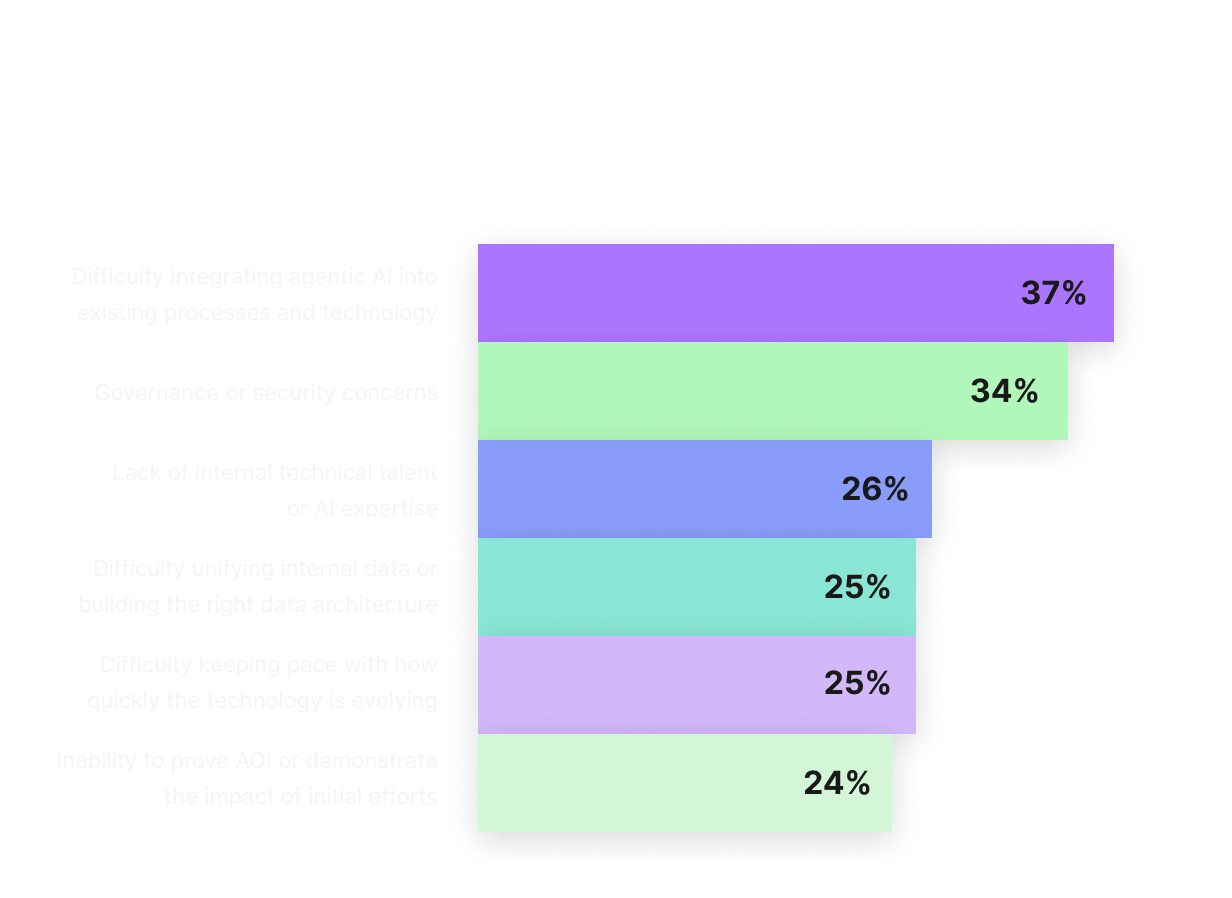
When we asked AI-facing enterprise leaders to tell us the significant barriers to agentic AI adoption at their organizations, two challenges stood out above the rest:
“Difficulty integrating agentic AI into existing processes and technology” — mentioned by 37% of respondents
“Governance or security concerns” — mentioned by 34% of respondents
A large gap separates those two concerns from the next four most common adoption challenges:
- Lack of internal technical talent or AI expertise - 26%
- Difficulty unifying internal data or building the right data architecture - 25%
- Difficulty keeping pace with how quickly the technology is evolving - 25%
- Inability to prove ROI or demonstrate the impact of initial efforts - 24%
While it fell outside the top three challenges for AI adoption, data readiness popped up as a major point of regret for enterprises during the deployment phase.
Among the 58% of our respondents who have agentic AI programs actively running in production, 78% encountered content or data readiness issues when deploying agentic AI programs that required significant rework or slowed their rollout, and a full 88% said that content and data infrastructure is an area they wish they had invested in earlier, before deploying agentic AI.


Among the total respondent pool, 90% said they would prioritize content and data infrastructure above any other investment if they were starting their agentic AI journey over again.

Don’t let your own enterprise learn this lesson the hard way. Connecting your content and data with your agentic systems should be the most fundamental step, not a box you check along the way.
According to Alexandra Jorge, Director, Marketing Consulting by EPAM:
“Content ecosystems must change not because it is a requirement for internal AI adoption but because the consumer of content is already evolved. Internal operational teams will be humans and agentic systems working together, end-users will also be humans and AI evaluating the value and offering of brands. Content ecosystems must be redesigned for both human and AI not because it is a program requirement but because it is a business demand.”
How content and data challenges drag down agentic AI programs
Agentic AI systems are only as capable as the content and data that power them. An agent tasked with personalizing a customer experience, orchestrating a multi-step workflow or retrieving the right information in real time is entirely dependent on whether the underlying content infrastructure can support that kind of dynamic, structured and reliable access.
According to our research, 58% of enterprises consider their content and data to be well-organized and readily accessible to support agentic programs. But for the other 42% of enterprises who haven’t reached that point yet, the pain points are constant.
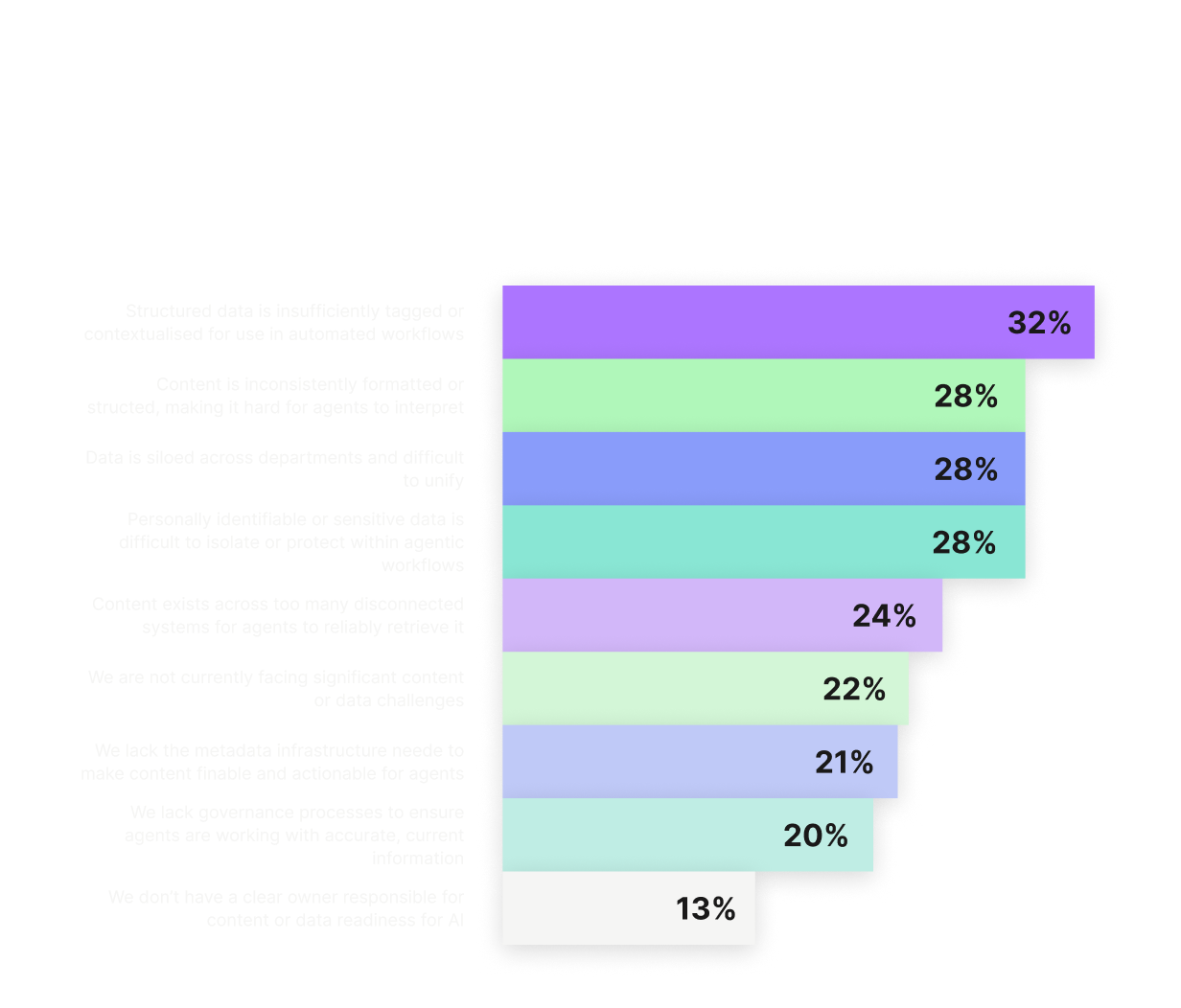
When we asked our respondents about the content and data challenges that their organizations currently face when it comes to supporting agentic AI programs, the most commonly cited blocker was “Structured data is insufficiently tagged or contextualized for use in automated workflows,” mentioned by 32% of the leaders who took our survey. Rounding out the top five were…
- Content is inconsistently formatted or structured, making it hard for agents to interpret - cited by 28% of respondents
- Data is siloed across departments and difficult to unify - cited by 28% of respondents
- Personally identifiable or sensitive data is difficult to isolate or protect within agentic workflows - cited by 28% of respondents
- Content exists across too many disconnected systems for agents to reliably retrieve it - cited by 24% of respondents
Beyond anything else, this inability to wrangle live data is the reason agentic pilots fail to scale beyond their initial scope. A proof of concept that looks compelling in demo conditions breaks down when exposed to the complexity of real enterprise content environments.
And if you can’t trust your agents with sensitive internal or customer data, pushing them into production is an absolute non-starter.
Recommended reading — AI governance and security: An essential guide for enterprises
4.You can’t prove ROI without measurement
Are enterprise brands struggling to get ROI from agentic AI, or do they simply lack the measurement infrastructure needed to see the value?
We asked our survey participants to describe how their organization currently tracks the impact of agentic AI programs, and learned that less than half of enterprises have formal measurement in place:
- 48% have clearly defined KPIs and are actively measuring against them
- 31% have some metrics in place but they are inconsistent or incomplete
- 17% are still figuring out how to measure the impact of agentic AI
- and 5% do not currently have any KPIs in place for agentic AI
When agentic AI is measured properly, the payoff becomes much clearer.
Among the enterprises who have clearly defined and actively measured KPIs, 94% report measurable positive returns from internal agentic AI programs (compared to 75% for the respondent pool as a whole), and 89% report measurable positive returns from external, customer-facing agentic AI programs (compared to 70% for the respondent pool as a whole).


How are enterprises tracking the impact of AI?
We know that measurement is critical for proving the ROI of AI programs. But what are enterprises tracking, specifically?
For the 48% of our survey respondents who said their organizations actively track the impact of agentic AI programs, here are the most common KPIs they measure against:
- Increased output or productivity by team members - cited by 59% of respondents
- Cost savings or reduction in operational spend - 51%
- Employee satisfaction or adoption rates - 47%
- Time saved for team members - 47%
- Customer satisfaction or NPS scores - 45%
- Conversion rate improvements - 43%
- Speed to market or cycle time reduction - 36%
- System uptime or reliability metrics - 35%
- Error reduction or quality improvement - 34%
- Pipeline or revenue value generated or influenced by agentic programs - 31%
Productivity, efficiency and speed dominate the KPI leaderboard for AI impact, while KPIs that speak directly to customer acquisition or revenue growth are less frequently pursued. Just 15% of our total respondents currently measure the success of their agentic AI programs by pipeline or revenue value generated or influenced.
According to Ryan Yockey, former VP of Engineering at The Farmer's Dog, enterprise teams need to ensure that any productivity metrics are focused on practical output.
"The first time I brought AI into a billion-dollar DTC business I started in customer service, then logistics and billing — repetitive work where the cost was already on the books, not the flashy stuff,” Ryan told us. “That's where the return showed up fast, because we graded it on whether the work actually shipped, not on 'time saved.' Treat the agent like a hire, not a feature. Keep a human on the approval until it earns the right to skip, and you get ROI you can take to a budget review."
We also asked digital leaders which benefits their leadership team is hoping to see from their company’s investment in agentic AI, and their answers reflected a similar C-suite focus on doing more with less.
The top 5 benefits that leadership teams want to see from their agentic AI investments:
1) Increased team member productivity and output (cited by 58% of respondents)
2) Cost savings (57%)
3) Faster decision making (55%)
4) Improved customer experience (53%)
5) Time saved for team members (52%)
The message that digital teams are getting from leadership on AI investment is clear: First, figure out how to do it faster and cheaper. Using agentic AI to improve revenue and customer experience are challenges for another day.
Of course, doing it faster and cheaper can lead to a reduction in quality if you haven't provided your AI workflows with the context and guidance necessary to be successful.
"If you're unhappy with the output, you probably under-invested in the input," says Elaine Ezekiel, Director of Marketing at Atomic Object. "Everyone expects AI to make work faster, and eventually it does. But the upfront work slows down first: tighter specs, a clear definition of done and a concrete plan for when things go wrong. Teams that skip that step get frustrated about why they aren't saving time."
5.How agentic AI is changing software budgets
AI spend is becoming an ever-growing line on the expense sheet, with 39% of enterprises saying their budget for AI-related software and tooling has increased significantly in 2026 compared to 2025, and 45% saying it has increased slightly.
On average, enterprises are spending 35% more on AI-related software and tooling in 2026 than they did in 2025. According to our survey respondents, the top areas of increased investment for AI in their organizations are:
- AI infrastructure and model access - cited by 58% of respondents
- AI-specific security and governance tooling - 52%
- Training, enablement, or change management for AI adoption - 49%
- Data and content management platforms - 48%
- AI observability and monitoring tools - 46%
- Developer tooling for building and deploying agents - 40%
- Orchestration and workflow automation tooling - 2%
But Agentic AI investment isn't happening in a vacuum. As enterprises commit resources to building and scaling agent programs, those dollars are naturally shifting away from other parts of the software stack.
30% of our survey respondents said their organizations are actively reducing or reconsidering at least one existing software category because of agentic AI, and another 42% are currently evaluating their current stack to make potential reductions.
In light of what agentic AI is capable of, leaders are actively questioning software categories that until recently seemed untouchable.
Where are enterprises cutting spend to fund AI investment?
We asked our enterprise leaders to tell us the software categories that they were either reconsidering or reducing spend on as a result of agentic AI capabilities, and these were the most popular responses:
- Customer support or helpdesk software (e.g. Zendesk, Intercom, Freshdesk) - cited by 45% of respondents
- Standalone chatbot or conversational AI tools (e.g. Drift, Intercom, older chatbot builders) - 43%
- Business intelligence or analytics platforms (e.g. Tableau, Power BI, Looker) - 43%
- Legacy content management systems (e.g. WordPress, Sitecore, Adobe Experience Manager) - 39%
- Marketing automation platforms (e.g. Marketo, HubSpot, Pardot) - 35%
- Standalone search or knowledge management tools (e.g. Elasticsearch, Guru, Confluence) - 35%
- Digital asset management platforms (e.g. Bynder, Widen, Canto) - cited by 31% of respondents
- Rule-based automation or RPA tools (e.g. UiPath, Automation Anywhere, Zapier) - 29%
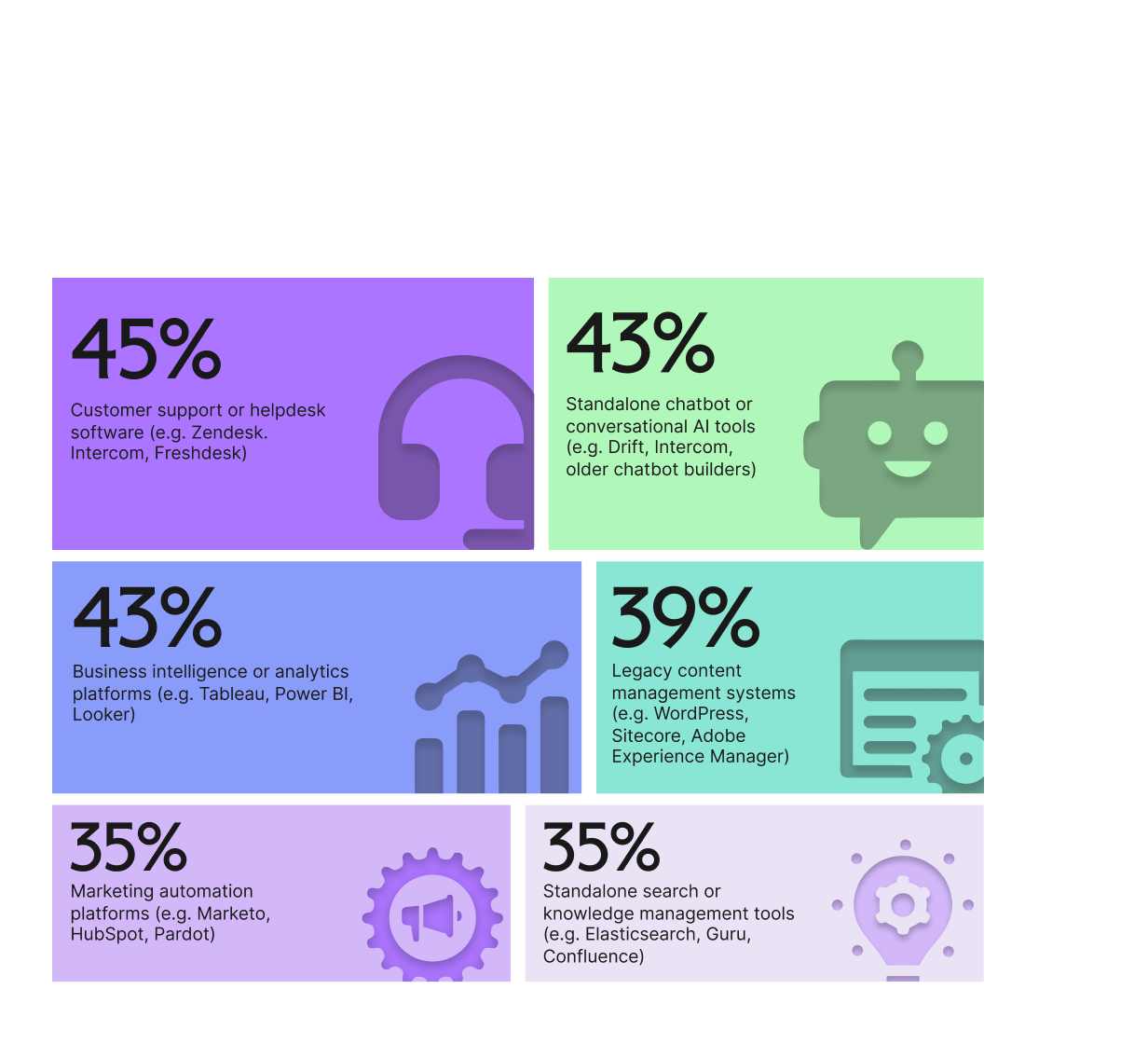
Legacy CMS platforms being a top focus for reduced spend reflects the ongoing transition away from traditional content management, and a shift towards modern digital experience platforms that unite content, data and agentic AI.
According to the enterprises we polled, 85% of organizations are explicitly evaluating whether their current CMS or content infrastructure is equipped to support agentic use cases, and 86% expect to consolidate two or more existing platforms into a unified infrastructure layer within the next 18 months, in part because of agentic AI.


6.What AI readiness actually looks like
Above all else, our research suggests that most enterprise leaders aren’t failing at agentic AI. They are attempting something genuinely difficult — building new operating models on infrastructure that wasn’t designed for them, at a pace set by external pressure rather than internal readiness, without clear benchmarks for what good looks like.
The overwhelm is real. The uncertainty is legitimate. And the feeling of being behind is very widespread.
What separates the organizations making real progress from those stuck in perpetual planning mode is the unglamorous operational groundwork underneath the flashy launches:
- clarity on who owns both the creation and the adoption of agentic programs
- content and data infrastructure that agents can actually work with
- KPIs that make impact visible before it gets questioned, and
- the organizational discipline to move from siloed departmental experiments to programs that function as shared, scalable infrastructure.
But none of it works without reliable content and data powering it. Of the leaders we surveyed whose agentic AI programs are tracking on or ahead of expectations, high-quality, accessible data and content infrastructure was the most important factor they credited in keeping their agentic AI program on track.
Adaptive experience at scale requires an architecture where content, data and AI agents operate as a single system. That’s the promise of Contentstack Agentic Experience Platform (AXP), which unifies content, real-time data and AI-driven automation into a single operating layer for digital teams.
By connecting structured content, brand knowledge and live data with autonomous AI agents, Contentstack AXP reduces manual work and enables enterprises like TIME, Golfbreaks and XCentium to launch personalized digital experiences with greater speed and control.
Schedule a demo with us, and we’ll show you how Contentstack AXP can help your organization evolve from the experimentation era of AI to the impact era.
13 key takeaways from Contentstack’s 2026 Agentic Enterprise report
Our research found that…
- 86% of enterprise leaders believe that the long-term success of their business will depend on how effectively they deploy and adopt agentic AI. But only 40% of enterprises have agentic AI programs actively running in production that are used by multiple departments.
- 78% of enterprise leaders encountered content or data readiness issues when deploying agentic AI programs that required significant rework or slowed their rollout; 88% wish they’d invested more in content and data infrastructure before deploying agentic AI.
- 82% of the enterprise leaders we surveyed said their organization has encountered at least one significant barrier to agentic AI adoption. The most commonly-cited barriers to agentic adoption were difficulty integrating agentic AI into existing processes or technology (37% of respondents) and governance & security concerns (34%).
- 42% of the enterprise leaders we surveyed told us that the lack of a clear internal owner directly delayed an agentic AI initiative at their organization in the past 12 months.
- Increased team member productivity & output (cited by 58% of enterprise leaders) is the top benefit that leadership teams want to see from their agentic AI investments, closely followed by cost savings or reduction in operational spend (57%).
- 31% of enterprises have inconsistent or incomplete metrics in place to track the impact of agentic AI programs; 15% are still figuring out how to measure impact of agentic AI in the first place.
- A combined 79% of digital leaders describe the overall progress of their organization’s agentic AI programs in 2026 as either on track or ahead of their expectations; among those companies, “high-quality, accessible data and content infrastructure” is the most commonly cited factor for their agentic AI program being on track.
- 52% of digital leaders feel they have the resources they need to pursue agentic AI at the pace the business requires; on average, enterprises are spending 35% more on AI-related software and tooling in 2026 compared to 2025.
- Among the enterprises we polled, the creation of agentic AI processes is primarily the responsibility of a central IT or engineering team (47%), followed by a dedicated AI or data function (25%).
- Among the enterprises we polled, the adoption of agentic AI processes is primarily the responsibility of a central IT or engineering team (37%), followed by a cross-functional team with members from multiple departments (28%).
- 48% of survey respondents have clearly defined KPIs to track the impact of agentic AI programs and are actively measuring against them.
- Messy content and data are threatening otherwise promising projects. 32% of enterprise leaders say their structured data is insufficiently tagged or contextualized for use in automated workflows; 28% say content is inconsistently formatted or structured, making it difficult for agents to interpret; and 28% say data is siloed across departments and difficult to unify.
- 85% of enterprises are explicitly evaluating whether their current CMS or content infrastructure is equipped to support agentic use cases. 86% say their organization expects to consolidate at least two existing platforms into a unified layer within the next 18 months, in part because of agentic AI.
7.About our participants
Research for this report was powered by Kickstand, and included 621 respondents who met the following criteria:
- Live in the United States (49% of respondents), United Kingdom (39% of respondents) or Germany (12% of respondents)
- Fluent in English
- Employed full-time at a company with 500+ employees
- Director-level or above; 39% of respondents were C-suite/presidents/owners
- Lead AI strategy or implementation efforts at their company (77% of respondents) or are actively involved in those efforts (23%)
For more digital experience industry research and benchmarks, visit contentstack.com/resources.
8.About Contentstack
Contentstack is redefining how modern digital experiences are built and managed. As the pioneer of the Agentic Experience Platform (AXP), Contentstack brings together structured content and brand governance (Content Cloud), real-time customer data, omnichannel personalization (Data Cloud) and autonomous AI orchestration (Agent OS) into one unified system.
While many organizations adopted headless CMS or standalone AI tools expecting transformation, they often found themselves managing disconnected systems and manual workflows. Contentstack helps enterprises move beyond that complexity by connecting content, data and AI in a way that makes digital experiences faster to launch, easier to manage and more adaptive in real time.
Leading brands including Steve Madden, LG Electronics, Subaru of America, Dolce & Gabbana, 1-800-Flowers, Decathlon and Caesars Entertainment rely on Contentstack to reduce operational friction and deliver personalized, scalable digital experiences with confidence. The company is known for its customer-first culture and commitment to the communities it serves through the Contentstack Cares program.
Learn more at contentstack.com.