

Closing the engineering gap and designing AI that marketers can own with Jack Virag
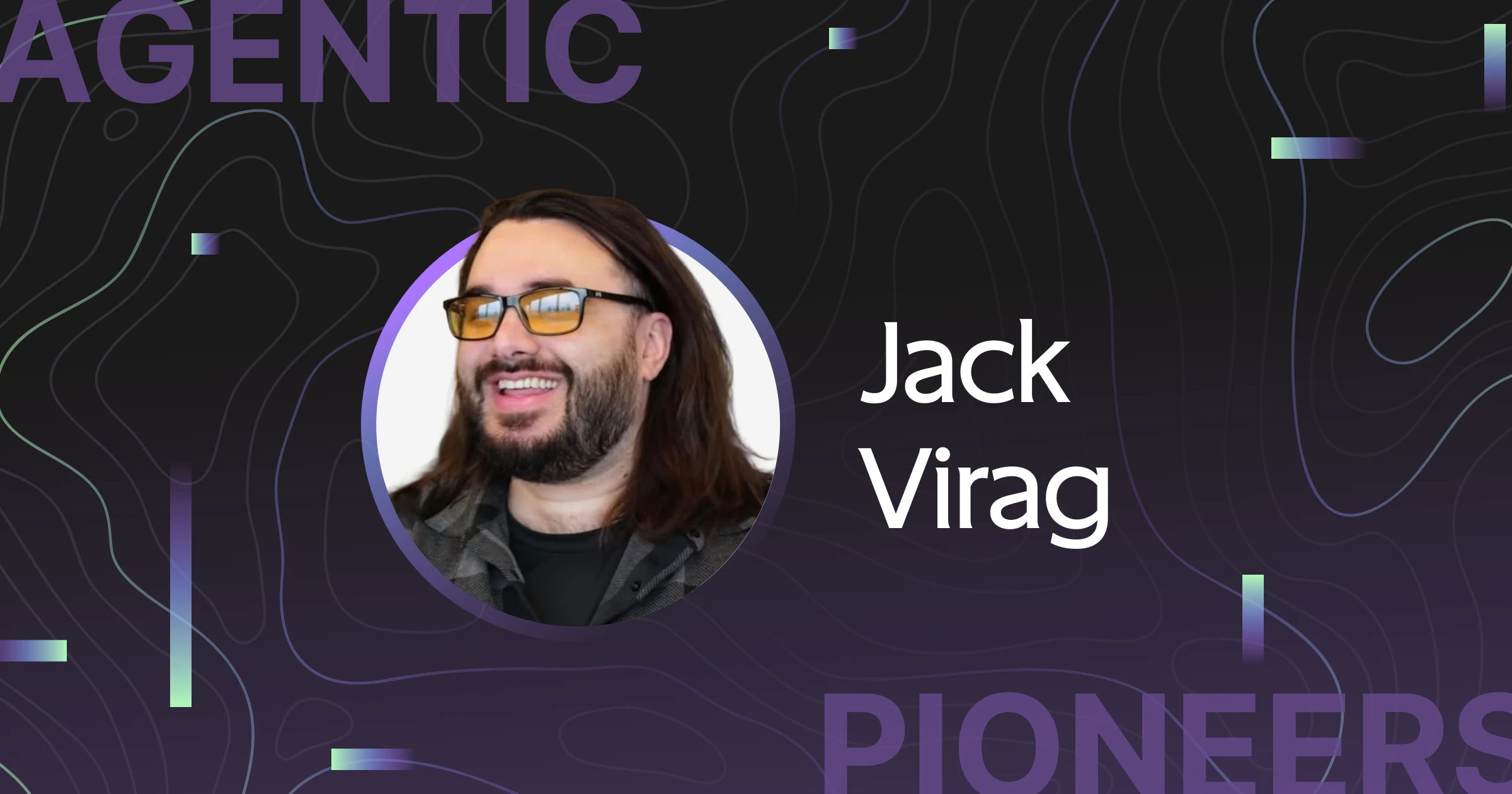
By Ben Goldstein
Before the rise of AI, Jack Virag made his living as a content marketer, spending his workdays writing personality-packed blog articles, designing SEO programs and shaping the editorial voice of lean, fast-moving tech companies. (And yes, being a LinkedIn memelord when he wasn’t sharing more serious insights.)
Jack was working as a Senior Marketing Manager at Statsig — a product development platform later acquired by OpenAI for $1.1 billion — when ChatGPT launched in late 2022. The team around him was mostly engineers, and the pressure to keep up was immediate.
“Love it or hate it, AI is the new paradigm of how people are going to work,” Jack tells Contentstack. “I’ve got a family. I don’t want to have to adapt when it’s too late.”
Within a year of ChatGPT’s release, Jack was hacking together mini-workflows, training custom GPTs on his company’s CSS and HTML and building the kind of practical automations that most marketing teams were still relying on their engineering teams for.
“I was always looking for little level-ups like that,” Jack says. “Now I sit on a throne of them.”
Currently leading AI Ops at Miro, Jack helps stakeholders across his organization build AI programs that help them hit their KPIs and streamline their work. He also recently launched Deadwater AI, a consultancy that builds internal AI architecture for companies who want to stop paying for someone else’s system and start owning their own.
The thread connecting all of it is a conviction Jack has carried since those first Statsig experiments: that marketers are better positioned to do this work than anyone else.
1.The shift
When Jack joined Statsig, the team was small by design. Leanness was a point of pride, something the company talked about publicly. When there was valuable work to scale and no headcount budget to hire for it, he needed to look beyond traditional solutions.
“It can take six months to prove the case for more headcount,” Jack says, “whereas it takes one conversation to get more tokens for your AI provider.”
His earliest experiments were rough in the best way. Before AI coding assistants existed, he used the AI search and AEO platform AirOps to string together code steps with LLM calls, building classification and sentiment workflows that could pull content from a CMS via API, run it through a model and push results back up, all without touching their CMS interface.
“We later used that same architecture to go through our entire blog,” Jack explains, “pull the posts through the API without navigating the CMS at all, then run AI on them: ‘What is this about? How long is it? Which of these four audience segments does it appeal to?’”
By the time he moved to Reforge as AI Marketing Lead, the tools had matured and so had his instincts. He was designing content systems with meticulous knowledge layers and explicit decision trees, guardrails that gave the AI instruction every time it hit a judgment call rather than letting it guess. The pattern that took shape at Reforge would later become the core of Deadwater.
2.The marketer’s superpower
There’s a version of this story where Jack’s background in non-technical content marketing is a limitation he had to overcome. He tells a different one.
“I think a lot of marketers have been held back by the fact that they couldn’t write code,” Jack says. “Fewer engineers have been held back by the fact that they don’t understand marketing. I think that the bleed of skills is more one-way in favor of marketers than it is for engineers,” he says.
Jack’s argument isn’t that engineers build bad tools. It’s that they tend to build tools shaped by engineering priorities, and marketing teams feel the difference. He points to the first wave of AI-generated content that flooded the web after ChatGPT launched: high-volume, hollow, engineered for output.
“Anyone can build an AI slop machine,” he says, “but you will succeed if you know how to not do that and build something that’s really great. I’d rather have me building the stuff that helps marketers than an engineer building it.”
His years writing with voice and humor — building newsletters that got reply rates that made industry benchmarks look like a rounding error, editing content that people actually forwarded to each other — gave him a working definition of what AI-generated work is missing when it misses. That sensitivity travels with him into every system he designs.
“I’ve always maintained that humanity is the core thing that people latch on to,” Jack says. “Taste is the center of all this.”
3.Independence as a service
Deadwater AI isn’t a content agency, and Jack is deliberate about that distinction.
“I don’t want to be an ongoing content shop for people, turning the key for clients month after month.” Jack says. “What I’m doing at Deadwater is giving them a really smart tool that can help with strategy, make decisions, write content. I just want them empowered enough that they have this system and can make those calls themselves.”
He builds with Claude Code and Codex, which he describes as his “two co-workers.” No proprietary platform sits in between. He reviews a client’s internal documentation, interviews their team, and turns everything into an AI architecture calibrated to how that particular company actually operates. When he hands it off, the client can use it, modify it and grow it themselves.
“Engaging with a client involves getting access to their Notion workspace, understanding their brand guidelines and positioning, and finding ways to turn all this knowledge into skill trees and workflows that are customizable and editable,” Jack explains.
His two target clients are lean solo marketers managing SEO, product marketing and website maintenance simultaneously, and the technical founder who doesn’t have a marketing team yet and needs a system that can help them make decisions, find their first customers and think through their positioning.
Both of these personas are working without enough support. Both benefit from something that doesn’t just execute tasks but helps them figure out what to do next.
“The biggest thing that I’ve learned is not as much about AI or marketing as it is about the fundamental power of context,” Jack says. “If your AI understands your entire business, and every time you ask it something it thinks about your entire business — or at least the parts that it needs to think about — it’ll be right.”
4.The road ahead
Jack’s advice for marketers who want to stay ahead is simple, and a bargain in the long run.
“I’d encourage people to try an expensive AI plan for a month and just try to build something with it and see what happens,” he says.
Jack suggests picking something you do manually on an ongoing basis — a process, a report, a formatting task, anything that feels like a tax on your actual work. Marketers, he argues, already understand more than they give themselves credit for: how websites are structured, what a CMS collection does, what CSS is even if they’ve never written a line of it. That’s enough to give an AI agent real direction and get something working.
Even if nothing ships, something real has happened. “You’ve brought yourself closer to engineering,” Jack says. “You are now more of an engineer than you were.”
The bigger picture, as he sees it, is that every company will eventually have its own internal AI: a dedicated system built on context, owned by the team and shaped by the people who actually use it. He doesn’t want good companies to get stuck choosing between expensive tools they can’t quite afford and the friction of doing everything manually.
With Deadwater, Jack wants to give companies the architecture they need and step back. Meanwhile, he continues looking for ways to ensure marketers have a starring role in AI’s future.
“Marketers put engineers on a pedestal sometimes because they can write code, and you can’t,” Jack says. “And the TLDR is that you can.”
5.Meet the pioneer
Jack Virag is an AI operations and marketing builder who helps teams turn company context into practical AI systems they can actually own. He works on AI Ops projects at Miro and is the founder of Deadwater AI, where he builds internal AI architecture for lean marketing teams and technical founders.
Across roles at Statsig, Reforge, Tavus, Nutshell and Miro, Jack has built CMS infrastructure, content engines, AI workflows and content programs that helped fast-moving companies scale through pivotal stages, including three successful acquisitions. Follow his work at deadwater.ai or his writing at jaaack.substack.com.