

Omnichannel strategies: Pioneering superior customer service

Share

Discover the power of omnichannel strategies to elevate your customer service. Embrace innovative solutions that lead the market and ensure seamless experiences for your clients. Follow our guide for actionable insights and case studies on proven omnichannel tactics.
Highlights
You’ll learn:
Become a customer experience champion with proven omnichannel strategies.
- Personalize the experience: Tailor interactions to the needs and preferences of each customer
- Enhanced customer trust: Deliver omnichannel customer service content that helps you build loyalty and trust
- Cross-platform consistency: Deliver and maintain uniform omnichannel support across all channels
- Mobile optimization: Ensure your website and other customer service digital channels are responsive and mobile-friendly for on-the-go access
- Agile channel activation: Train your staff and set up the right technology to adapt to new communication platforms quickly
A composable DXP offers the right technology to set you on the path of omnichannel success. Sign up for a free demo today.
Keep reading to learn more!
A Bain & Company report states that brands with a customer experience focus grew their revenue by up to 8% above their market. But how does this relate to the omnichannel approach?
Omnichannel strategies for optimum customer service
Businesses are using omnichannel strategies to enhance their customer service as it helps them unify digital customer experiences, whether via sales and after-sales support or omnichannel retail.
Yet, doing that across multiple digital channels poses a challenge. A composable DXP provides the answers, powering omnichannel strategies that help businesses address their customer service challenges.
All about omnichannel strategies
To understand omnichannel strategies, think of an orchestra. On their own, each instrument delivers great tunes, yet the conductor unifies them into a beautiful symphony that engages the audience.
The conductor is the omnichannel approach, and the instruments are all the digital channels that combine to create the digital customer experience.
An omnichannel strategy is a sales and marketing method that uses multiple integrated channels to deliver a seamless and consistent customer experience. It gives consumers the chance to find and buy in-store, online, or wherever that is easiest for them.
With the right tools, you can enhance omnichannel strategies. For instance, a composable DXP collects data with which you can refine your brand message and create relevant and tailored digital solutions for your customers.
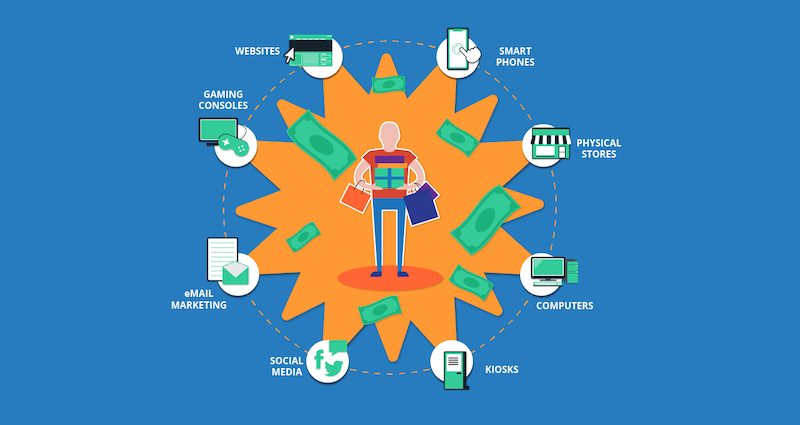
Omnichannel customer service and evolution of customer service
So, why should you bother about customer service? A Salesforce report states that 88% of customers will buy again if the customer service is good, and 80% consider the customer experience to be as vital as the product or service.
Forrester also states that 41% of brands focusing on customers grew their revenue by at least 10% more than the previous year. It is clear that people value great customer service and will reward the effort you invest in it.
In the early days, customer service was mainly about the business transaction, and the customer journey ended after that. If customers needed help, it had to be during business hours.
Not anymore. Modern customer service is about meeting the customer where or when it is most convenient for them. You have to be available even after a sale, and you have to be wherever your customers are. That has prompted brands to set up various digital channels and contact centers to drive their customer engagement.
Customer service has moved through several stages to where it is today:
- Single-channel customer service: This was the era of direct communication channels, in-person or via traditional mail. Businesses operated in silos, and customer service reach was limited.
- Multi-channel customer service: With digital tech coming into play, brands expanded their customer service to include phones, email, and websites. Yet, they operated in silos, and there was little to no integration.
- Cross-channel customer service: This was when integration started to come into play, but it was only partially, and to a large extent, disjointed.
- Omnichannel customer service: This is the era of full integration of all channels. The omnichannel era unified all channels and offered a consistent way to deliver tailored solutions.
Fast-track digital experiences with Contentstack. Need to create digital experiences quickly? Contentstack's content and editorial engine enables you to reach new markets and create digital experiences faster. Manage content with ease and speed. Start your free trial today.
Current trends and future of omnichannel customer service
Current trends
Omnichannel customer service aims to tailor digital customer experience through AI and automation. Businesses are also using integrated data systems to track the customer journey, enabling them to get a unified view.
Another current trend is the focus on mobile, in line with the global trend of mobile phone usage. Statista says 64% of the global population had a smartphone as of 2022, up from 51% in 2015. In the United States, 92% of the populace uses a mobile phone, according to another Statista report.
These realities are driving digital customer experience strategies, ensuring that brands focus on mobile apps, mobile-friendly interfaces and websites, and SMS support. They are also expanding their customer support reach via social media.
Future predictions
The future of customer service omnichannel strategies could depend on predictive analytics that will enable you to anticipate customer needs based on their history. AR and VR could also come into play, offering a more immersive customer experience.
For instance, customers could rely on AR to visualize how a product fits in their space before they buy it. And with data safety becoming a topical issue, blockchain technology could offer a more transparent way to manage and secure data.
Finally, as voice assistants gain more ground, they could also play a part in future omnichannel customer service strategies. That would require businesses to adapt their content for voice commands.
Benefits of omnichannel customer service
Customers enjoy 24/7 support and faster resolution on various channels. For businesses, they can reach a wider audience, build trust, and generate quality leads. There are also other benefits of omnichannel support, as follows.
Increased customer loyalty and higher sales
Research shows that using omnichannel customer service and strategies increased sales by 494% compared to single channels. A Harvard Business Review report also found that omnichannel customers spent 10% more online and 4% more in the store.
Higher customer engagement
According to Think With Google, omnichannel strategies boost store visits by around 80%. The Milligan Foundation boosted web traffic by 400% after implementing omnichannel strategies powered by Contentstack’s composable DXP and headless CMS. There is ample evidence that omnichannel strategies lead to more engaged customers.
Improved customer satisfaction
Omnichannel support helps customers resolve problems faster, and they can reach brands on all channels. They also enjoy seamless user experience, 24/7 access to a support team, and faster response to their inquiries. All these factors lead to customer satisfaction.
Crafting your omnichannel strategy
1. Evaluate your current customer service model: Consider customer interactions and communication channels. Audit your social media, phone support, in-store experiences, phone support and any other channel you use. Also, look at the customer journey to find any gaps.
2. Leverage technology: Invest in a CRM system to give you a unified view of how customers interact with your brand across all channels. Use data analytics tools to get insights into their behaviors. Automate repetitive tasks to free up time for your team. You may also use chatbots to interact faster with customers.
3. Train your staff: Develop a team that prioritizes the needs of customers and train them to be proficient in all your digital channels. Set up ongoing training to ensure they keep up with the rapid changes in technology and customer service methods.
4. Measure your success: Set up metrics to track your performance. That may include response times, net promoter score (NPS), customer satisfaction scores (CSAT), resolution times, Etc. Use surveys and social listening tools on social media to track customer sentiment. Then, iterate and use the data to optimize your customer service strategies.
Challenges of implementing omnichannel strategies
Certain issues could hinder your omnichannel approach, as follows:
- Potential high costs.
- Privacy and security concerns for multiple channels.
- The cultural shift for your team.
- Dealing with many channels can be complex.
- Issues with integrating tech platforms.
Understanding these challenges will help you prepare for how to tackle them.
Overcoming the challenges
Here are practical ways to manage any fallout from implementing omnichannel customer service strategies.
- Use a phased approach to save costs.
- Have a clear guideline for brand consistency.
- Train your team on omnichannel strategies and technologies.
- Use a centralized customer data platform.
- Set up robust security policies and adhere to industry standards.
Tech innovations shaping omnichannel strategies
- Customer data platforms: CDPs centralize data from various sources, enabling omnichannel strategies that power-tailored customer support on all unified channels.
- Cloud computing: Cloud computing boosts scalable and flexible omnichannel strategies, allowing brands to integrate various channels while they remain accessible.
- AI and machine learning: They enable tailored, interactive services via automation and predictive analytics, ensuring your omnichannel strategies are proactive.
- Blockchain technology: It enhances omnichannel strategies by offering reliable data security across channels. This secures the digital customer experience and fosters trust.
Case studies
Cartier
Despite their extensive customer digital experiences, Cartier struggled to harmonize the platforms. Brand alignment was poor, and some of the platforms were outside their control.
To correct this, they opted for Contentstack's composable DXP, which offers omnichannel content delivery via a headless CMS and automation. The result? Strong brand alignment and better ROI on content assets.
Hear from Anastasia Goglova, the Digital Lead. "The websites that are such a critical part of our digital portfolio are now more aligned and more performant. As a result, the customer digital experience of Cartier improves, reflecting our commitment to becoming a reference for luxury in all aspects."
Read more about how Cartier improved operational efficiency and brand integrity.
MTR
MTR had two reward programs—one for customers who shop in their malls and the other for transit riders. However, the programs were not aligned.
Choosing Contentstack’s composable DXP with a headless CMS enabled them to integrate with existing MTR channels and unify their points loyalty program. The transition to omnichannel strategies enabled them to scale content delivery to millions of app users.
Read how MTR delivered an enhanced omnichannel experience to their rail riders.
Leader in content experience platforms. The Aragon Research Globe™ award recognizes how Contentstack’s low-code, easy content creation and publishing and advanced front-end hosting redefine customer experiences. Join our group demo to experience this dynamic solution.
FAQ section
What is an omnichannel strategy?
An omnichannel strategy is an approach to sales, marketing, and customer service that integrates all customer service channels to provide a unified and smooth experience, regardless of how or where a customer reaches out.
Why is omnichannel customer service important?
It is critical because it is all about the customers and their needs. It creates speed and convenience and shows customers that you have optimized to solve their problems. That fosters trust and brand loyalty.
How can technology improve omnichannel strategies?
With AI, chatbots, and CRM systems, businesses get access to customer data, interactions and behavior that enable them to offer reliable, consistent, tailored, and efficient customer service across channels.
What is an omnichannel customer care platform?
An omnichannel customer support platform is a collection of unified channels that brands use to interact with their customers.
How do you create an omnichannel strategy?
To create an omnichannel strategy, first audit your current strategy to find gaps and opportunities, then explore how and where technology can make it better. You also want to train your staff on managing multiple digital and physical touchpoints. Finally, set up analytics to enable you to track and improve your performance.
Learn more
Delivering omnichannel customer service comes with challenges. Yet, it offers many benefits. It boosts sales, improves customer retention and leaves the customers satisfied. Omnichannel strategies enable you to create and deliver consistent and tailored customer experiences.
So, if you are ready to elevate your customer service through omnichannel strategies and support, Request a free demo to see how a composable DXP helps.