

Scaling customer guidance and beating spreadsheet fatigue with Ravi Althuru
By Ben Goldstein
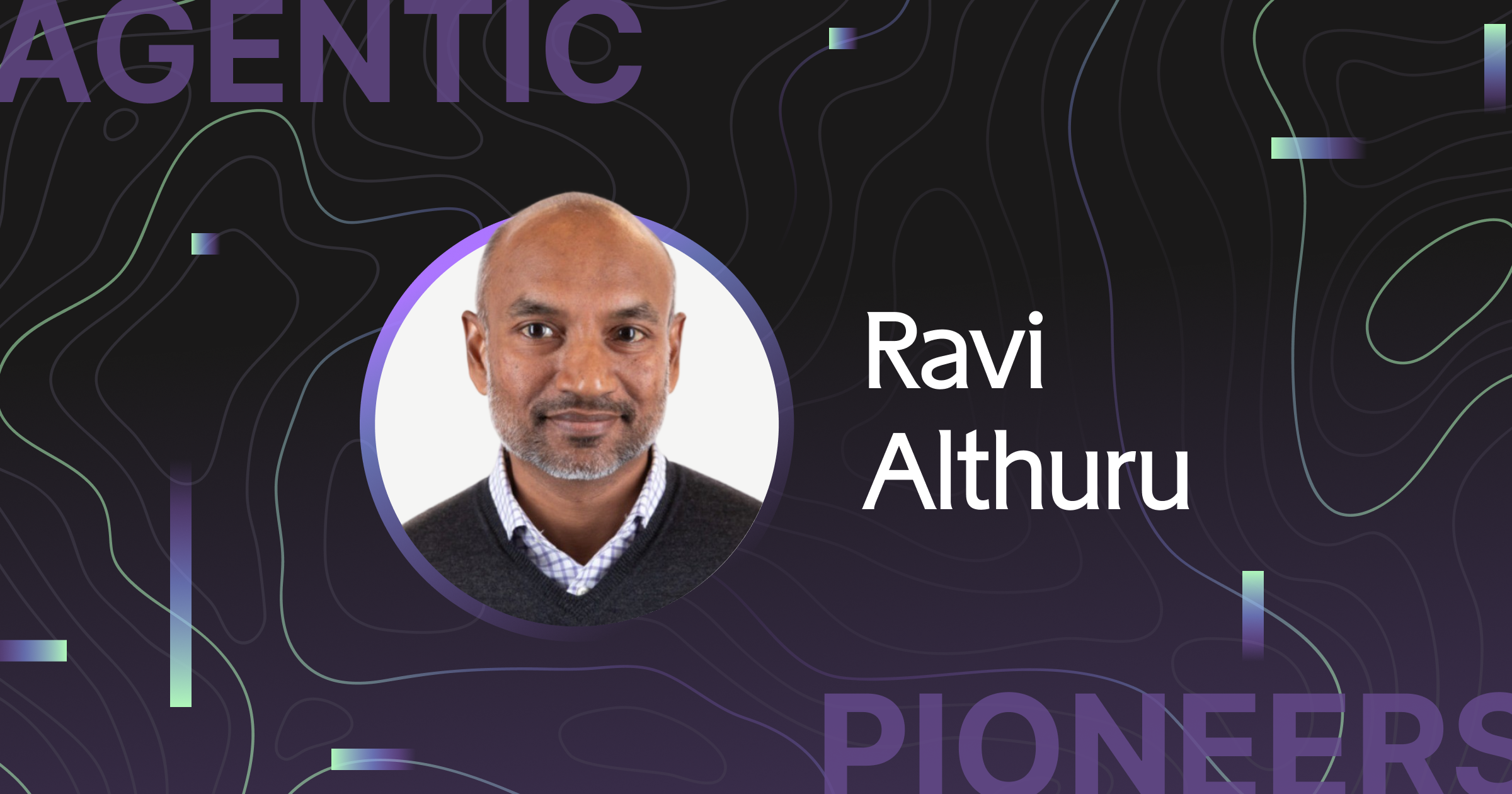
As the Senior Director of Business Strategy & Optimization Services at Algolia, Ravi Althuru leads a team dedicated to proving the tangible value of on-site search and discovery.
Part of that work involves providing subject matter experts and best practices to Algolia’s customers, who include such big names as Walgreens, Gymshark, Zenni and Shoe Carnival.
The other part of the team’s mission is what Ravi refers to as value engineering analysis, a data-driven function that aims to quantify the impact of what Algolia’s customers are paying for.
“Our team looks at our customers’ data regarding how they're leveraging Algolia on their site. We then provide guidance on what they should consider to improve their search and discovery experiences,” Ravi tells Contentstack. “Or, if they’re using competitor products, we can provide uplift calculations showing the impact and benefits of using our platform instead.”
Ravi describes value engineering as a “proactive motion” meant to solve the common SaaS-world challenge of customers trying to figure out the ROI of their investments on their own, and not always seeing the full picture.
“We came up with value engineering to provide a mechanism for our sales teams to show prospects what they could realistically achieve if they move to our solution, and to give existing customers deeper detail into how search and discovery is working across their site and identify improvement opportunities,” Ravi says.
1.The spreadsheet bottleneck
First launched in February 2024, Algolia’s value engineering process would take the customer’s product data, run data modeling and analysis of search terms and categories, then provide its output in the form of spreadsheets.
From there, either a solutions engineer (for new customers) or a member of Ravi’s team (for existing customers) would step in to do the analysis.
“We added checkpoints and improvements along the way, but a lot of this analysis required field team members to go through the spreadsheets and look at the data manually,” Ravi says. “It took a lot of time because they also had to validate it against the customer's website.”
It was a bottleneck that cried out for an agentic solution. So, starting in May 2025, Ravi began overseeing the creation of an AI assistant that analyzes Algolia Search data for prospects and customers.
Made up of a team of individual AI agents, the assistant was designed to understand overall search and category performance health, get diagnostic feedback on zero results and problem queries (i.e., what's underperforming, the biggest improvement opportunities and potential root causes). It can also provide recommendations on using Algolia functionality to remedy customer issues.
“The agents essentially take the data that we were providing through the spreadsheets, perform the analysis and present a summary and best practice recommendations for our customers to focus on,” Ravi explains.
Needing a name for the internal project that reflected its value engineering roots, a member of Ravi’s team suggested “Agent Valentina,” which immediately stuck.
2.The building process
Algolia’s value engineering process has its own data model that performs analysis on the customer's search data. Agent Valentina automates the data analysis using seven specialized AI agents that work in parallel, each focusing on a different aspect of search performance.
“In terms of the AI models during development, we've tried it with both OpenAI and Claude,” Ravi says. “What we found is that Claude was producing more detailed, in-depth and reliable technical analysis compared to OpenAI. We tuned the tool to improve with Open AI and are currently using that for testing and roll out.”
By the summer of 2025, Algolia’s first experiments with feeding spreadsheets into OpenAI evolved into what Ravi calls “an orchestration layer and architecture for agentic experiences,” which Ravi’s team began building that September to coordinate their agents and manage parallel execution. “More importantly, we decided on our requirements and goals for this agent and what the output should look like.”
A few months later, Ravi’s team had achieved a fully functional pilot solution with all their agents working together, performing the analysis and even creating visuals such as charts showing the distribution and performance of a customer’s search and discovery queries.
“I would say January [2026] is when we felt comfortable showing it to other team members to get more feedback, and then we started rolling it out,” Ravi says. “And we've been using it internally for our customers’ data analysis ever since then.”
3.The impact
Value engineering used to require a week of manual data analysis for each customer. Thanks to their new agentic process, Ravi’s team has been able to significantly reduce that timeframe.
“[Agent Valentina] gives us the outline of what to focus on in terms of our talk track and the visuals, then it takes us a day or two to finalize the presentation text,” Ravi explains. “But I would say we’ve reduced the amount of time we’re spending in doing this analysis by 60-70%.”
For one customer, Valentina discovered a high zero-results rate for certain category pages which revealed a broken internal process related to how they manage campaign end-of-life situations.
Currently, Ravi’s services team is the primary user of Agent Valentina, in addition to a couple of solutions engineering team members who are doing beta testing. Ravi’s plan is to offer the agentic tool to the wider field organization, especially customer success managers and solutions architects who can use it to prepare for QBRs.
“Right now, our QBRs are fairly basic in terms of looking at customer analytics and the customer’s own metrics,” Ravi says. “What we hope is that customer success managers can feed in analysis on a particular customer, then use information generated by Agent Valentina to supplement their materials and talk tracks.
“We see this being used by a lot of internal team members, especially on the customer success and service sides.”
4.The road ahead
Ravi believes that his team has only scratched the surface of the impact that Agent Valentina — and future agentic programs — can have in his organization.
“There are other areas we can expand on with Agent Valentina itself, be it generating a complete slide deck that could be leveraged by the team or deeper analysis on the merchandising side of things ” Ravi says.
He also sees opportunity in agentic tools that provide customer-facing guidance and support on their own, especially during the initial setup phase.
“Search can be very subjective and opinionated,” Ravi explains, “so we want to use AI to provide a point of view for customers and say, ‘Based on your vertical and use case, this is a configuration that we recommend that you should use.’ That takes away the ‘cold start,’ if you will, so that our customers can quickly get to something good and effective that they can iterate on in the future.”
As with other digital leaders who have found value and solved real problems with their early agentic experiments, the success of Agent Valentina has inspired Ravi and his team to stay on the leading edge of AI.
“The bottom line is, over the past year we've seen more tangible ways of leveraging AI than ever before,” Ravi says. “We’re constantly exploring and expanding in this space. Though there are caveats, we are learning so much more about how to work with agents and we want to continue this journey.”
5.Meet the pioneer
Ravi Althuru is a Senior Director of Business Strategy & Optimization, with a proven track record of driving AI-powered search, discovery and digital experience transformation across global enterprises.
He leads strategic initiatives at Algolia, a leader in AI-native search, and brings deep expertise in search relevance, personalization and conversion optimization, leveraging modern AI/ML-driven platforms to unlock measurable business outcomes.
Ravi advises customers and prospects on best practices and guides them through their product discovery journey.