

Reinventing disaster relief and sales engagement with Jonathan Greenberg
By Ben Goldstein
Jonathan Greenberg’s career has touched finance, sales, marketing, revenue strategy and humanitarian work. But as he sees it, one thread ties all of those disciplines together: turning signals into action.
“There's intelligence out there,” Jonathan tells Contentstack. “How can you as a company or a department synthesize it and make it easy for your team to make better decisions?”
While at Hubspot, Jonathan became interested in translating sales and marketing insights into guidance for the product team. He started his own agency to help other companies implement signal-to-action motions, and used the concept to launch a humanitarian platform called SOS.
1.“Everyone is a helper”
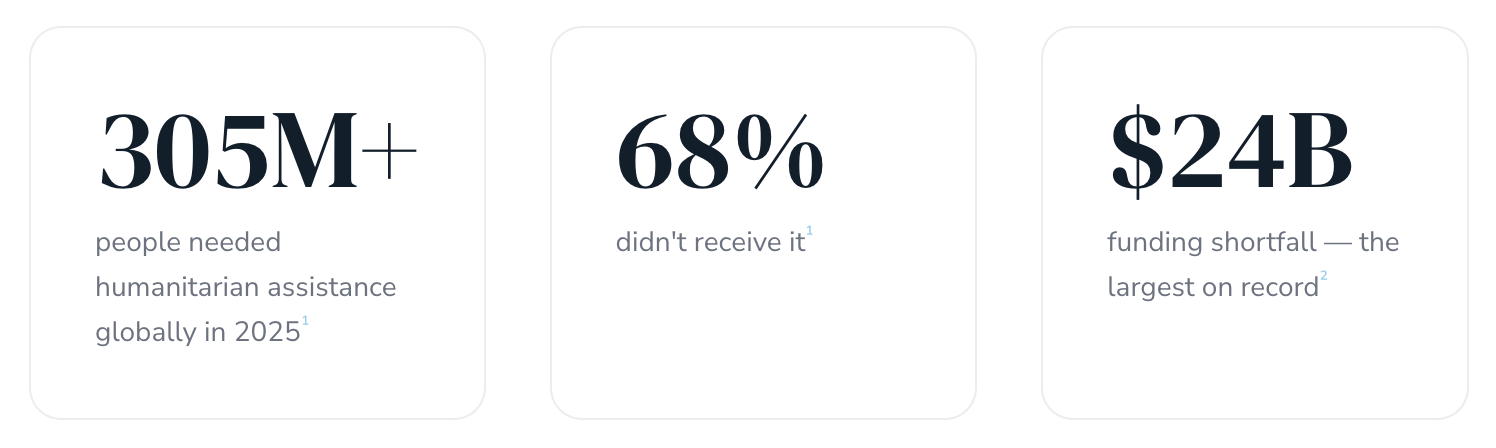
In September 2024, Hurricane Helene hit the Southeastern U.S., including Western North Carolina where Jonathan lives. Thousands of people went missing, and there was no centralized system to find them.
“So many nonprofits and individuals wanted to help but didn't know where to go to either find or give that help,” Jonathan says.
“I used HubSpot and AI to build a database that helped surface 4,000 missing people — that was the ‘signal’ we needed. Then we used Lovable to get to a working prototype, which helped us attract our first round of funding.”
In order to develop a legitimate MVP of the platform, Jonathan used an AI stack that included OpenClaw as the orchestrator, Anthropic's Opus as the model, Claude Code for development, Supabase for the database and Slack as the team interface.
“Now we're onboarding our first NGO partners — Emergency RV, Aid Arena and Free Hot Meals — and closing in on the first agentic-forward community coordination platform,” Jonathan says.
What makes SOS unique is Jonathan’s philosophy that “everyone is a helper.”
“We've seen people who lost everything clearing debris from their neighbors' driveways to get them out,” he explains. “People using their donated RVs to cook meals for others. Sales guys who started nonprofits delivering RVs across the country.
“There’s no ‘survivor’ category in the system — the platform treats them as people first. All of us move between needing help and giving help.”
2.Solving one of the toughest problems in sales
Breaking through the noise is a constant challenge for GTM teams, and it’s one that Jonathan has been trying to crack in his professional life for years.
“When I was first in sales, they'd give you your five links to send to prospects [after a call],” Jonathan says. “But put yourself in the buyer’s shoes: Busy people don't want to read through generic information. I noticed that the more you can customize your communication, the better the deals went. It’s just that all the deck-building and cutting-and-pasting of logos takes forever.”
After joining Reforge in September 2025, Jonathan spent about a week with Opus 4.6 and OpenClaw to hack together an initial solution to this particular bottleneck.
“I grabbed all of our sales transcripts for a whole quarter and created a discovery analysis asset for my CEO to see if there was any opportunity there,” Jonathan explains. “It was like, ‘Here's a bunch of files, here's the foundation of context, let's go analyze five of my calls. I was actually shocked with how well it worked. I thought, ‘Alright, now let's try this for one of the companies we’re selling to.’”
After some iteration, Jonathan had what he wanted: an agentic system that takes the team’s Gong recordings, analyzes them and generates fully personalized microsites and follow-ups based on what the buyer actually said in the call.
3.The process
Though he’s been an early adopter of AI tools, Jonathan admits he’s “not a coder at all,” and had to ask his agent the right questions to wind up with something functional.
“I had set up OpenClaw right when it came out,” Jonathan says. “I'm not super technical; I understand the technical side, I just can't execute it. So I was asking the model a bunch of questions like, ‘Hey, what should I do to create an actual live web page?’”
“My stack ended up becoming Anthropic API with Opus as the model, and OpenClaw as my orchestrator. Vercel has been a great addition to spin up these quick sites. And then I use Slack as my main organizational channel to communicate with the agent.”
After fine-tuning the visual presentation and branding of the output, Jonathan began using his new tool to send custom follow-ups to buyers just two days after the prototype was built. Now, his co-sellers and the engineer on his team use the tool as well.
While the personalized microsites have been very well-received by Reforge’s prospects, one of the most common replies he gets is: “How did you build this?” Jonathan has been seeing similar interest lately from smaller nonprofit organizations that need ways to scale their operations.
“One of the things I've discovered in the NGO world is you have these massive organizations that are heavily resourced, and really small ones that can’t hire enough people to support their growth,” Jonathan says.
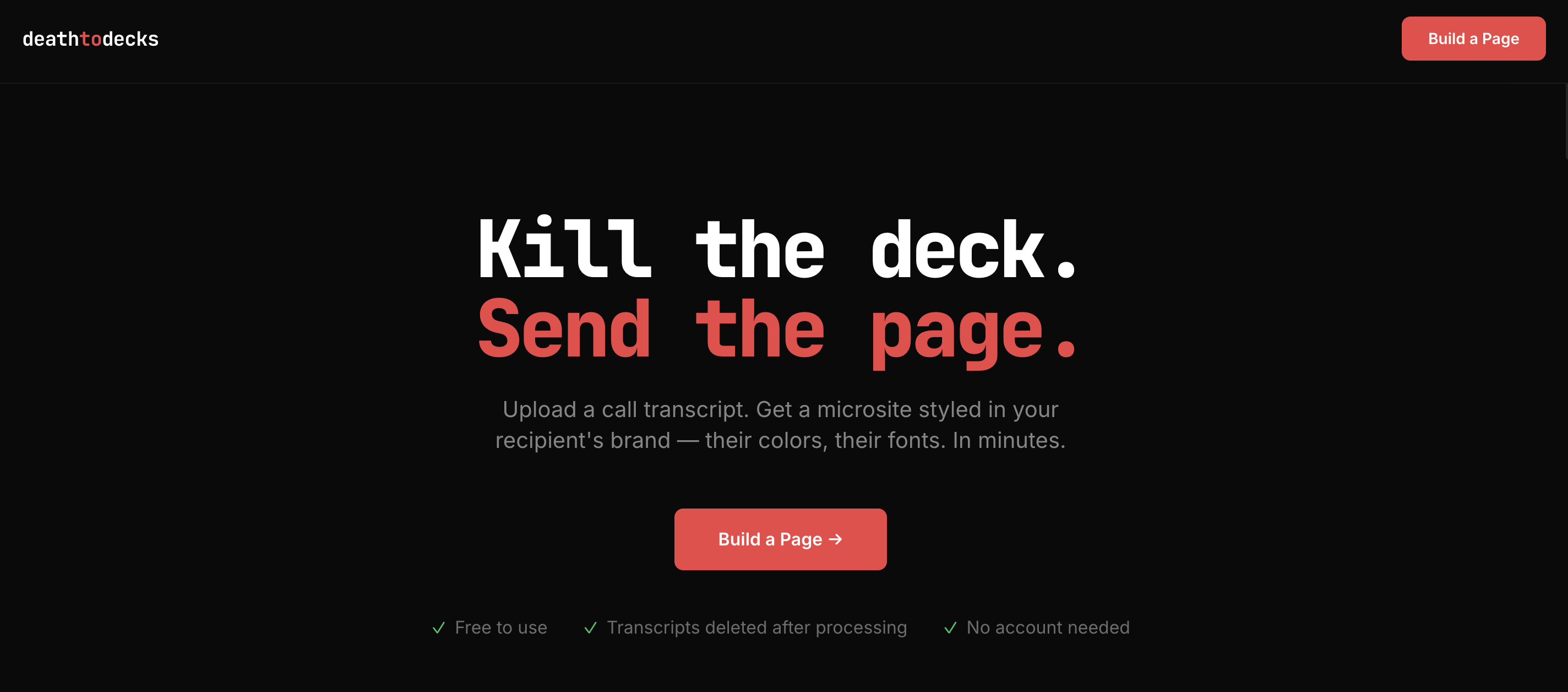
“So I decided to try productizing it one night for [people outside of Reforge] to use as well, and that's when I built Death to Decks, which lets people drop in a transcript and get a follow-up site to share immediately.”
4.The road ahead
Whether he's building personalized microsites for sales prospects, algorithm-driven feedback tools for LinkedIn creators (PostRoast), intelligence systems for private equity clients (HarmonyStrategy) or a coordination platform for disaster relief, Jonathan Greenberg keeps returning to the same question: How do you take scattered information and turn it into decisions that actually help people?
“That’s the common thread for all of this work,” Jonathan says. “Signals in, better decisions out. And I can apply that pattern everywhere I see signals going to waste.”
Jonathan’s biggest ambition with Death to Decks is to simply get it in the hands of more people as a free tool so he can collect more data, while building other agentic products that help people get more human time back in their lives.
“I'm not putting a ton of expectations on making this into a massive thing, but the feedback has been so positive that I want to continue to improve it, and add more templates beyond just follow-ups,” Jonathan says. “I’m an inventor at heart, and I know that the more feedback you have on whether people are finding something to be useful or not, the less it matters if you think it's a good idea.”
As for the original tool he built for Reforge, Jonathan’s next step is quantifying its impact.
“I would love to be able to connect this tool to deals influenced,” Jonathan says. “Having worked in marketing, I know that everybody wants to get attribution for the thing they feel brought in the deal. But right now I can tell you that this tool has saved me hours per week, and I believe it has upleveled the way I'm communicating our message, while staying true to my authentic voice.”
For agentic builders like Jonathan, finding efficient ways to use AI opens up more opportunities to create, and makes it possible for passions to become reality.
“Over the last few weeks I had this idea to use agents for the disaster platform, I've got a GTM role with a brand new company I'm trying to figure out, I have a bunch of clients for my agency, and I thought, ‘Wow, I could use these tools to not only save time in my work life and produce a better output, but also pursue these things that I'm super curious about and have been passionate about for a while,’” Jonathan says.
“If people don't like them, that's fine. But I have to scratch that itch and say, ‘Alright, I went after this thing. What's next?’”
5.Meet the pioneer
Jonathan Greenberg is an AI strategist, ex-HubSpot revenue leader and founder of SOS (sosconnect.org), an agentic community coordination platform for disaster relief. His agency Harmony Strategy helps companies implement signal-to-action systems, and his products Death to Decks and PostRoast turn sales recordings and LinkedIn posts into data-driven, personalized output.