

Leverage data-driven insights for omnichannel success

Share

With data-driven insights, your omnichannel strategy can take on a new, far more productive form. By sourcing the right data, you can integrate and analyze that data to find trends and patterns to capitalize on. Consider the essential role of technology and opt for a composable DXP to power your omnichannel approach. Register for a free demo to see how a composable DXP supports your omnichannel goals.
Highlights
Laern how data-driven insights help you achieve your omnichannel goals.
- Use quality data: Always prioritize data quality. Deploy the right technology, integrations, and governance to ensure access to quality data
- Target the right channels: Know where your customers are, know what they want, find them on those channels and deliver tailored solutions that resonate with them
- Personalize content: How else can you show your customers that you care about their needs? Understand what they want and deliver personalized content every time
- Analyze and act on the insights: Follow the numbers. Uncover trends and patterns and use them to adjust your omnichannel approach
Follow the above steps to create meaningful solutions for your audience and ensure you use the right technology. A composable DXP is the missing piece. Sign up for our demo to see how it works.
Keep reading to learn more!
A recent report states that brands that focus on omnichannel solutions raised their revenue by around 10% and retained 90% of their customers. As online and offline experiences continue to get more integrated, customers want to be able to switch between both with minimal fuse.
Omnichannel strategies enable businesses to offer that, and it has become a necessity for them to remain relevant and competitive. Here is a deeper look at the impact of data and analytics on the omnichannel approach, its benefits, and steps to implement it.
The power of data analytics in omnichannel retail
When a customer interacts with your brand on various channels, they leave a trail of data that relevant analytics tools pick up and store. You can leverage that data to create omnichannel retail strategies that deliver tailored solutions and seamless shopping experiences.
In that sense, a data-driven strategy drives omnichannel retail. It gives you proper and adequate customer data with which you can make decisions that improve your retail and customer service and drive sales.
How data analytics can enhance customer journey optimization
- Segment the customer base: Data analytics gives you a clearer understanding of your customers and their channels with your brand. That way, you can deliver experiences that resonate with each segment.
- Tailored content: Customers prefer products and services that speak to their unique needs. With data analytics, you can understand these needs and tailor your content, offers, and products accordingly.
- Predictive analytics: You can improve your supply chain and inventory management based on predictions from customer interactions, behaviors and buying patterns.
- Feedback analysis: You can also improve the customer journey by analyzing their interactions with your marketing channels. You can use data from social media analytics, surveys, and feedback forms to achieve this.
- Engage in real-time: Your customers may face difficulties when shopping. Real-time analytics enables you to act and resolve such issues, further improving the customer experience.
Modernize your digital presence with Contentstack. Learn from the success stories of Icelandair and Pella. Improve your site performance, publishing efficiency, and speed, just as they did. Start your journey towards a modern digital experience. Start your free trial with Contentstack today and witness an ROI of up to 295%.
The importance of omnichannel analytics
Tracking customer behaviors
You can improve many parts of your business just by understanding customer behavior and how they interact with you on various channels. Things like their buying patterns, sentiments, order status, preferred payment channels etc, become clearer to you. You use these insights to improve your operations and the entire shopping experience.
Refining the omnichannel experience
With omnichannel analytics, you can get a granular view of your channels and how customers interact with them. That enables you to craft content and offers that suit them. It also enables you to find gaps in your customer service and omnichannel strategy.
Integrating composable DXP in omnichannel
A composable DXP is a modular, API-first, cloud-native SaaS platform. It combines best-of-breed digital tools and integrates them via APIs and microservices to address specific business needs using a headless approach. You can build agile systems with a composable DXP.
Composable DXPs use centralized data from which you can optimize the digital customer journey and manage content and campaigns. It integrates a suite of tools that enable teams to create, analyze, manage, and deliver omnichannel experiences.
Through a headless CMS, a composable DXP also helps you deliver structured content to your customers on any channel or digital device, be it mobile apps, wearable tech, voice assistants, vehicles, or even IoT devices.
The role of composable DXPs in omnichannel strategy
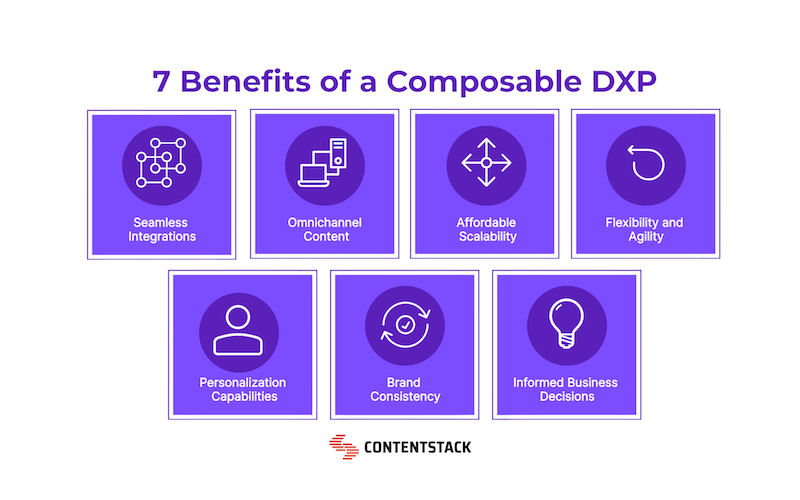
A composable DXP offers an agile, flexible, and scalable platform that helps to create cohesive and tailored digital solutions across all channels.
As the customer journey changes, it adapts to the new data. That way, you adapt your strategies based on the most recent data. Here are other roles as follows:
- Better touchpoints: It removes data silos, which improves the quality and access to data. Also, various teams managing each channel can collaborate better, leading to a more unified omnichannel customer experience.
- Helps you scale: A composable DXP can scale up or down without any effect on the whole system. It supports the dynamic nature of an omnichannel. So, brands can add new channels and features based on demand or changes in the industry.
- Supports innovation and agility: Through its modular approach, brands can adapt quickly to market changes or shifts in tech and customer behavior.
- Data-driven insights: Composable DXPs integrate with analytics tools. So you can gather and analyze data for the omnichannel approach and customer journey optimization.
- Seamless integration: This works for both existing and new technology stacks. You can integrate new tools and services with composable DXPs to future-proof your omnichannel strategy.
Tools and technologies for omnichannel analytics
CRM systems
CRM systems help manage customer data. It collects data from multiple sources, harmonizes it and presents it in an easy format. It enables you to improve how you relate with your customers. It also helps you to find and nurture leads.
Customer data platforms (CDPs)
A CDP collects and combines customer data from multiple tools to create a single central database. It includes data from all your channels and customer interaction with your brand, product, or service. It can be broken into several parts to create more tailored digital solutions.
E-commerce analytics tools
E-commerce analytics tools track and analyze online shopping behavior, conversion paths, and how customers engage with your brand. You can use these data to optimize the online shopping experiences and integrate them with your offline channels.
Marketing automation tools
These tools analyze customer data and automate marketing actions across channels, ensuring you can deliver consistent messaging and targeted campaigns.
Social media analytics tools
Social media tools allow you to track interactions and trends. You can also track the sentiment towards your brand. Data from social media analytics help you craft a content strategy and improve omnichannel customer service.
Steps to setup data-driven strategies in omnichannel
- Define your goals: Every brand has its unique goals. You may want to increase sales, boost customer service, retain more customers, Etc. This objective will guide how you collect and analyze the data.
- Map the customer journey: The customer is always at the center of any omnichannel strategy. So, note the various channels your customers use, including physical and digital touchpoints.
- Identify data sources: You cannot enjoy the benefit of data analytics when you have bad data. So, identify sources of data and ensure they have the right data for your analysis. You can look at social media tools, your CRM system, or data from your physical store.
- Data collection: Collect all data required and integrate it into a central database to ensure it is consistent and easy to access. This will also remove data silos and improve data quality.
- Data governance: Without this, you can run into issues like data silos and compliance issues. Identify and classify your data, then set up policies for data integrity and security. Once done, create internal data standards to control data usage.
- Analyze the data: Once data governance is in place, you will have a stream of accurate data to build your analysis. You can use relevant tools like Power BI, Looker or other analytics tools to analyze the data.
- Apply the insights to your strategy: Finally, apply the results of your data analysis. Use it to improve your customer service and business operations. Also, track your progress and adjust as required.
Contentstack: Your partner in scaling digital experiences. Twice named a Leader in Forrester's composable DXP award, Contentstack offers an innovative approach to DXP. Experience our 100% microservices architecture and API coverage that allows instant scalability. Start your free trial today.
Future trends in omnichannel analytics
Emerging trends, such as AI, will enhance the ability to forecast customer behaviors and preferences. Real-time omnichannel analytics will also become standard as it will enable brands to provide support on the spot.
The Internet of Things (IoT) will also come into play. It will enrich data sources, while standard organizations and governments will continue to insist on data privacy, security and ethics.
By keeping tabs on these trends, you can prepare for a data-driven future and stand out from your competitors.
Case studies
Cartier
Cartier, a leading luxury brand, had an extensive suite of digital assets. Yet, it was not unified or integrated. Hence, the brand was not aligned.
Contentstack's DXP enabled them to move to a data-driven omnichannel strategy. That led to proper brand alignment and higher ROI on their content assets.
Anastasia Goglova, the Digital Lead, had this to say. "The websites that are such a critical part of our digital portfolio are now more aligned and more performant. As a result, the customer digital experience of Cartier improves, reflecting our commitment to becoming a reference for luxury in all aspects."
Read more about how Cartier improved operational efficiency and brand integrity.
Dawn Foods
Dawn Foods took orders via phone and in person before 2019. It was disjointed.
Contentstack enabled them to enjoy the benefits of a composable DXP for e-commerce integration and omnichannel retail. It also boosted online orders by 50%.
Gireesh Sahukar, Vice President of Digital, had this to say. "We know that we have made a really good decision choosing Contentstack. We’re extremely happy with our partnership. The kind of flexibility that Contentstack offers, not just to us, but also to the ecosystem partners that we want to work with, is pretty fantastic."
Here is how Dawn Foods found a recipe for success.
FAQ section
How important is real-time data in omnichannel strategies?
Real-time data helps you make timely decisions that help your customers. It enables you to boost your customer service strategy as you can respond to the needs of customers on the go.
How does data analytics improve omnichannel customer engagement?
Data analytics enables brands to know the needs of customers, and by so doing, it leads to tailored interactions and better service delivery across all channels.
What issues might brands face in implementing omnichannel strategies?
Some notable issues are data silos, data security and issues with integrating data from many different sources. Without dealing with these issues, brands may find it hard to achieve their omnichannel goals.
How can brands measure the success of omnichannel strategy?
Brands must state what metrics they want to use to measure their progress. That could include customer retention rate, conversion rates or ROI from their omnichannel.
Are there any specific industries that benefit more from omnichannel strategies?
Every industry can benefit from omnichannel strategies. However, those who have a heavy presence on digital channels and who rely on heavy customer interaction may benefit more from it. They include retail, banking, and health care.
Learn more
The idea of data-driven strategies in omnichannel retail is not just a fad. It has become a necessity as customer needs evolve and the world relies on big data. By understanding and applying insights from omnichannel analytics, you can create digital experiences that set you apart and drive growth.
It all starts with that first step. Key in today to transform your omnichannel strategy with data-driven insights. Request a free demo and see how a composable DXP helps you deliver omnichannel experiences.