

Build resilient systems with an API-first composable DXP

Share
.jpg?width=3840&quality=85&format=webp)
Learn how an API-first approach can transform your business by powering the quick delivery of optimum content and omnichannel experiences that resonate with your audience. Enhance agility, integration and resilience in your business tech with an API-first composable DXP. Request a free demo to see how it works.
Highlights
Learn why building agile and flexible systems with API-first composable DXP leads to:
- Adopting a MACH architecture: Opt for microservices, API-first, cloud-native, and headless solutions for better flexibility
- Prioritizing component flexibility: Stay true to the composable best-of-breed principle by choosing solutions that enable you to create custom experiences
- Leverage modern infrastructure: Opt for a composable tech stack for scalable and adaptable digital ecosystems
- Focus on integration: Go API-first and integrate all components of your DXP, including relevant third-party services for extended functionality
Take the steps to transform your digital infrastructure today. Switch to API-first composable DXP for optimum digital experiences. Request a free demo to get a firsthand experience.
Keep reading to learn more!
Rapid technological changes have made it essential for organizations to build agile and flexible systems. The API-first approach in composable DXPs helps them do that, ensuring they can build, manage, and optimize flexible and scalable digital ecosystems.
Here is a look at the core of API-first composable DXP, its significance, benefits, and practical steps to integrate it into your business strategy.
What is API-first? Understanding the API-first approach
The API-first approach is critical to building resilient systems because it supports a modular, scalable, and interoperable design. And an API-first composable DXP is key to that process.
But you may ask, what is API-first? The API-first approach is a modern software development method that focuses on developing and designing APIs before building software. It positions APIs as the building block of software and serves as a foundation layer for application development, enabling systems to interact and share data.
The API-first approach ensures that your digital services can adapt, scale and integrate with multiple systems, both internal and external. It caters to modern digital operations where integration has become a critical success factor.
How API-first enables the creation of more agile and flexible systems
- Decoupling of concerns: API-first separates the front end from the back end in development tasks. So, development teams can work and make changes to separate areas without waiting for or impacting each other. That increases agility and speed.
- Focus on customer needs: Agile systems thrive on feedback, and they also adapt to change. The API-first approach requires developers to focus on the needs of end users from the jump. Hence, APIs provide the functions and data needed, which leads to more user-friendly services.
- Flexibility and scalability: API-first designs are usually modular and reusable. It leads to faster updates and scaling, and it adapts easily to new technology. API-first design ensures that you can modify the system without too much work.
- Facilitates microservices: Microservices break down large applications into smaller units that interact via APIs. That makes the system to be more flexible and agile as you can deploy and scale each service on its own.
- Ecosystem integration: These days, system integration and unified have become essential to success. An API-first approach ensures that your systems can integrate with third-party tools and services, external partners, and platforms.
Modernize your digital presence with Contentstack. Learn from the success stories of Icelandair and Pella. Improve your site performance, publishing efficiency, and speed, just as they did. Start your journey towards a modern digital experience. Start your free trial with Contentstack today and witness an ROI of up to 295%.
The role of composable DXP in API-first strategy
A Composable DXP is a flexible digital experience platform that integrates a suite of “best-of-breed” modules that work together through APIs and microservices with a headless approach. Unlike monolithic DXPs, composable DXPs are modular. They are flexible, thanks to APIs that connect several units.
A composable DXP provides the modular architecture needed for agile, flexible, and scalable digital experience solutions. It acts as a central hub and facilitates seamless data flow for all your integrated systems, such as a headless CMS, marketing automation tools, e-commerce, CRM, Etc.
It also delivers a better user experience in an API-first strategy because by relying on APIs, it fetches data in real time for content creation across multiple digital channels. That enables you to personalize and tailor content to the needs of your customers.
A composable DXP supports integration, so you can integrate it with any technology stack, third-party services, and external partners that work with APIs. That enables you to extend the capabilities of your digital experience.
Benefits of API-first composable DXP
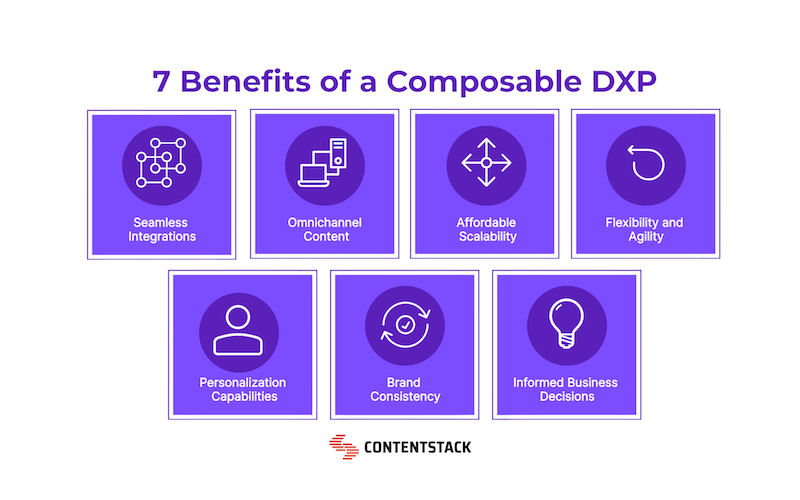
- Agility: An API-first composable DXP is also agile and flexible because it allows businesses to select the best solutions for each business function. That way, they can add or remove a solution without overhauling the entire system.
- Cost-efficiency: Based on its best-of-breed principles, businesses can only select the solution that is relevant to their needs. There are no lock-ins like in monolithic systems. So, you focus on the areas that deliver the most value to your business.
- Resilience: An API-first DXP uses a modular approach to isolate failure. So, if one part of the system goes down, it does not affect the entire system.
- More tailored content: A composable DXP houses customer data from different sources in a central repository. Digital marketers can pull the data to create tailored content that meets the expectations of customers.
- Improved time-to-market: Developers can work on different parts of the system at the same time, which leads to data sharing and speeds up work. With that, they can deliver new features and updates faster.
Adopting an API-first composable DXP: A step-by-step guide
- Evaluate your current tech stack: Take a good look at your current system and integrations. Set up an audit to enable you to find gaps and limitations. Note areas where your current system is neither flexible nor scalable. Also, obtain feedback from your developers and users to identify gaps in your current system.
- Define your goals: Clarify what you aim to achieve. You may want to improve user experience, deliver products and features faster, or scale. Whatever it is, clarify it, as your strategy hinges on that.
- Prioritize API design and development: Design your APIs before starting with your service's core. Set up data governance to ensure your APIs are secure and consistent. Design the APIs to be modular and to integrate with new systems easily.
- Deploy your APIs: Ensure your APIs are secure and accessible, and use the agile approach to ensure they are flexible. Create relevant documentation and deploy via the cloud for the best results.
- Track and iterate: Track the system and usage patterns to ensure it works as it should. Review your API strategy on a regular basis. Also, engage with developers to get their feedback; you can improve the system.
Components of an API-first composable DXP
The good thing about composable digital experience platforms is that you build them. So, you get to handpick the tech stacks that suit your business needs. You need some essential tools to get started, such as:
- Headless content management systems (CMS)
- Customer data platform
- analytics software
- Digital assets management (DAM)
- Marketing automation tools
- CRM.
- E-commerce solutions, Etc.
A composable DXP ties these tools and several others together with a flexible and scalable architecture. That allows you to tailor your digital experience platform while also enabling you to adapt and respond to change.
Overcoming implementation challenges
Although API-first composable DXP transforms your business, implementing it comes with some challenges that you must know about. Some notable issues include integration complexities, especially when dealing with complex, legacy systems.
You may also find it hard to get the buy-in of all stakeholders, including the management team, developers, and end users. Each one may have reservations or different priorities, and they may not entirely understand the benefits of API-first development.
To overcome these issues, use integration testing and unit testing to ensure APIs are working as they should. Also, use contract testing to check that services are interacting as they should based on their predefined contracts.
On issues of stakeholder buy-in, educate them on the benefits of going API-first. For better effect, use real-world examples and case studies to drive home your point. Also, engage them early in the process so that you can onboard and address their needs and concerns.
Tools and technologies for API-first development
The API-first strategy relies on several essential tools and technologies to succeed. That includes API management tools like Apigee and AWS API gateway.
These tools offer developer portals, API gateways, and analytics that enable you to track and enhance API performance when required.
Other relevant tools are API design, API development tools like Node.js and Django REST Framework, API testing tools like Postman and Jmeter, and API security tools like OAuth 2.0.
Microservices and cloud-native solutions can further enhance your DXP as they offer the ability to be agile, flexible and scalable.
Contentstack: Your partner in scaling digital experiences. Twice named a Leader in Forrester's composable DXP award, Contentstack offers an innovative approach to DXP. Experience our 100% microservices architecture and API coverage that allows instant scalability. Start your free trial today.
Future trends in API-first development
As digital technologies continue to advance, APIs will remain at the forefront of crafting immersive and personalized experiences. Emerging trends, like AI and ML in API development, will introduce more automation and lead to better efficiency.
Security will also be at the core of API-first development. The more APIs continue to be central to enterprise operations, the more cybercriminals will pose a threat.
So, there will be a greater focus on API security strategies, and more businesses will continue to adopt OAuth 2.1 and API gateways for enhanced safety and security.
Case studies
Burberry
After struggling to scale its legacy DXP, Burberry finally opted for Contentstack’s API-first composable DXP along with apps and integrations.
That enabled them to enhance their e-commerce and deliver tailored content to their customers. It also helped them boost publishing speed by 80% and reduced tickets to one per week from around 40.
Latoracca said, “Contentstack helps our engineers to move fast and concentrate on business requirements by reducing proprietary platform inconveniences. Adding new consumers has never been such an easy and pleasant journey for everyone.”
Read more about how Burberry enabled speed and agility through an API-first composable DXP.
Dawn Foods
Dawn Food’s order processing was not unified. They took orders via phone and in person before 2019. The two channels were not in sync, and they needed to change that.
Contentstack’s API-first composable DXP with a headless CMS offered them the right technology for managing content and delivering an API-first approach. It also improved customer experience, and online orders went up by 50%.
Hear from Gireesh Sahukar, Vice President of Digital. "We know that we have made a really good decision choosing Contentstack. We’re extremely happy with our partnership. The kind of flexibility that Contentstack offers, not just to us, but also to the ecosystem partners that we want to work with, is pretty fantastic."
Here is how Dawn Foods found a recipe for success via Contentstack’s API-first DXP.
FAQ section
What is an API-first approach?
An API-first approach prioritizes the design and development of APIs at the start of building applications or digital solutions. An API-first approach ensures that the system is flexible and interoperable.
What are the key components of a composable DXP?
The components of a composable vary by build and needs of a business, but it typically includes content solutions, customer data platforms, search, etc. So, you can expect to see a headless CMS, digital assets management (DAM), automation tools, and search tools.
How does API-first contribute to digital transformation?
An API-first approach supports digital transformation by enabling businesses to build more flexible, agile and scalable systems within a cohesive digital ecosystem. So, it fosters innovation and improves the customer journey.
Can you integrate third-party systems with a composable DXP?
Yes. Composable DXPs are modular and API-first, so they support integrations with third-party systems, tools and services.
What is MACH architecture and its relevance to composable DXP?
MACH is the short for microservices-based, API-first, cloud-native, and headless. It underpins the design principles of a composable DXP, focusing on efficiency and flexibility.
Learn more
An API-first composable DXP helps you build an agile, flexible and customer-focused digital presence. By prioritizing APIs in your development strategy, you can integrate the most suitable solutions that enable you to deliver top-notch digital experiences.
It also empowers your business to adapt to new business needs, market shifts and emerging technologies. Switch to an API-first DXP today to move your business to the next level. Sign up for a free demo and see firsthand how an API-first composable DXP can transform your digital strategy.